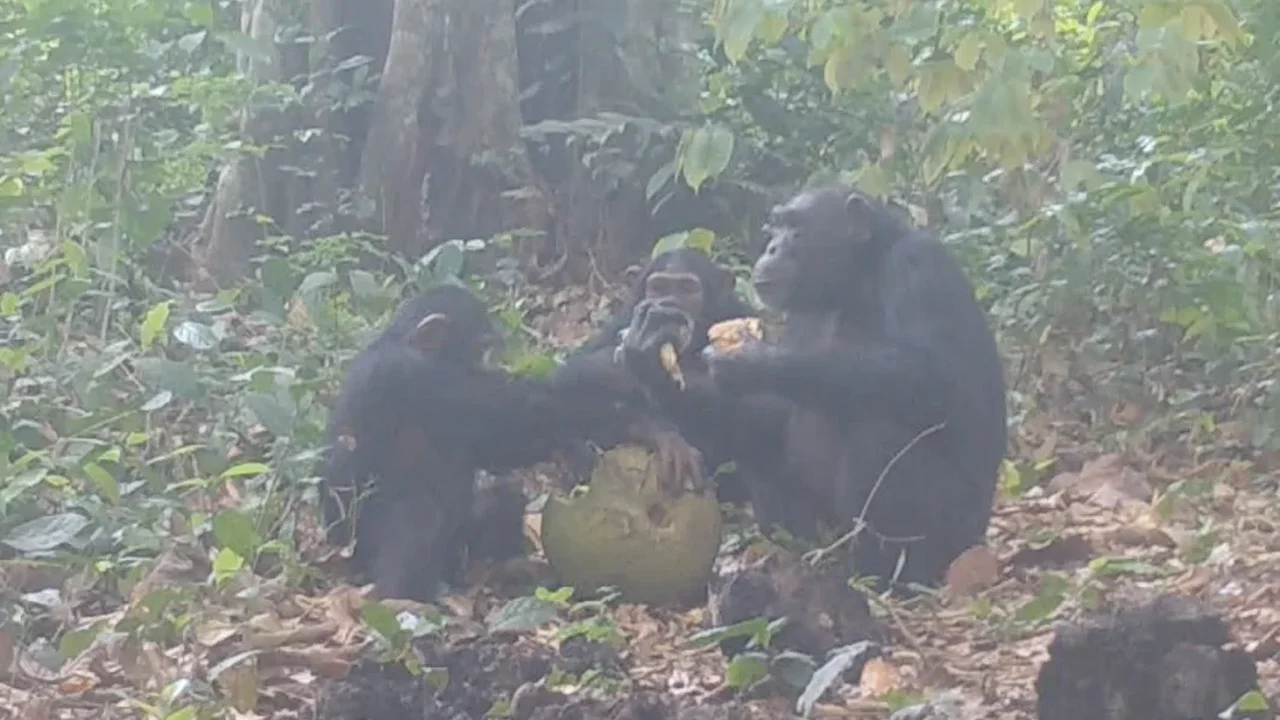
New observations from Guinea-Bissau's Cantanhez National Park suggest that wild chimpanzees are not only eating naturally fermented fruit, but also sharing it in ways that resemble human social dining.
What researchers observed
Using motion-triggered cameras, scientists from the University of Exeter recorded ten separate instances of chimpanzees feeding on African breadfruit containing ethanol. Laboratory tests showed alcohol levels reaching up to 0.61% ABV, a modest amount, yet notable in a wild primate diet.
Earlier work had already hinted that chimpanzees encounter alcohol often. In one long-term study in Bossou, Guinea, researchers documented repeated visits to raffia palms whose sap naturally ferments into wine. The new findings go a step further by showing that the animals also share fermented food.
Why it matters
According to primatologist Dr. Kimberley Hockings, food sharing is not constant in chimpanzees, which makes this behavior especially interesting. The team suggests the pattern could reflect an early form of communal feasting, where valuable food and social bonding overlap.
Follow-up research has strengthened that idea. Scientists analyzing fruit from Taï National Park in Côte d'Ivoire and Ngogo in Uganda found low but widespread ethanol levels across more than 500 samples. Because chimpanzees eat large quantities of fruit each day, even small concentrations may add up over time.
Researchers also detected ethyl glucuronide in urine samples from wild chimpanzees, offering direct evidence that the animals absorb and metabolize ethanol. Still, the alcohol levels are low, and the chimps are not thought to become intoxicated in the human sense.
One possibility is that fermented fruit signals ripeness and high sugar content, making it a useful food cue rather than a deliberate search for alcohol. Either way, the findings add a fresh layer to what scientists know about primate nutrition, metabolism, and social behavior.
Published in Current Biology, the research suggests that the relationship between primates and ethanol may be older and more natural than once assumed. It could help reshape future studies of evolution, diet, and the roots of social sharing in our closest relatives.