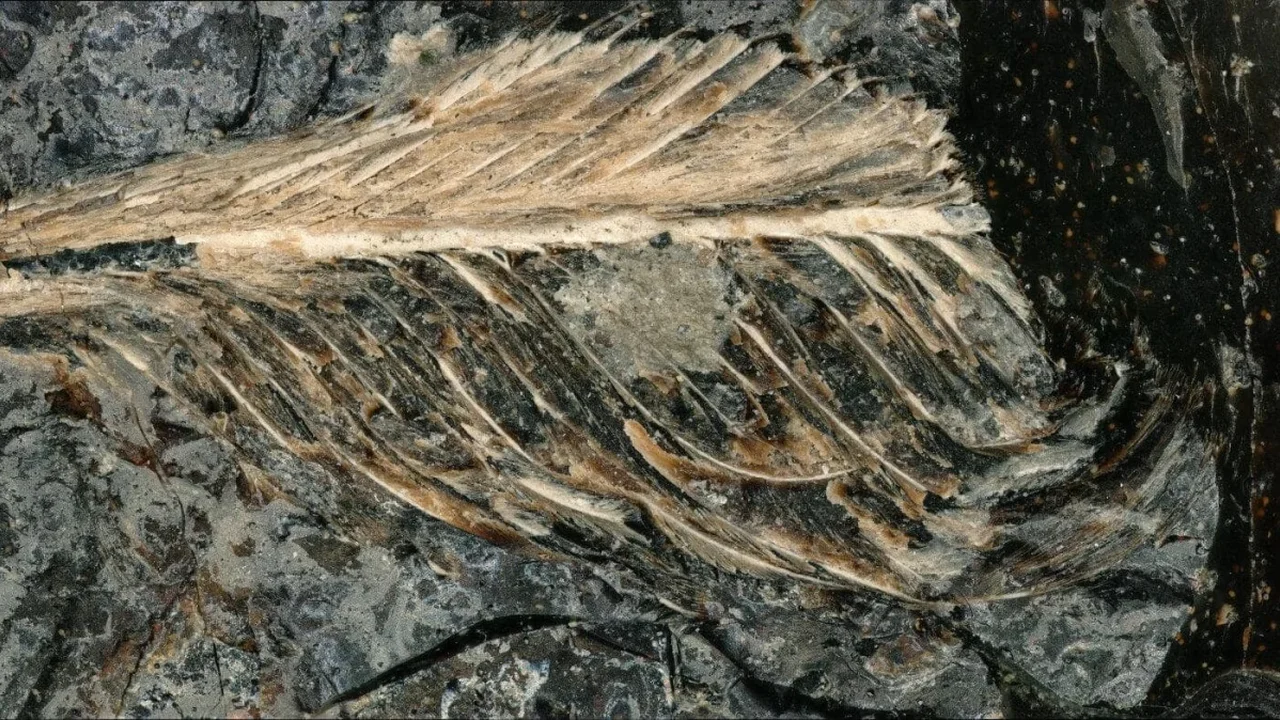
A small fossil from Montana's Hell Creek Formation has offered scientists an unusually detailed window into bird life at the end of the Cretaceous period. The specimen, a fossilized dinosaur dropping known as a coprolite, contains feathers, bone fragments and fish scales from a diving bird consumed around 66 million years ago.
Using micro-CT and 3D surface scanning, researchers examined the specimen without damaging it. They identified four feathers, including two wing feathers and two softer body feathers, alongside fragments of leg bones associated with hesperornithiforms, an extinct group of diving birds.
A remarkably preserved ancient feather
The standout find is a 9.3-millimeter primary feather that retained its three-dimensional form rather than appearing as a flattened imprint. Its lightweight inner structure and durable outer layer resemble key properties seen in modern bird feathers.
Scientists also identified a square feather shaft with a sponge-like internal structure, a feature not previously documented in feathers from the Mesozoic era. This suggests that several advanced plumage characteristics had already evolved among birds before the end-Cretaceous transition.
Clues to prehistoric bird adaptation
The wing feathers appear suited to a water-based lifestyle, with structures that may have helped maintain insulation and reduce water penetration. The body feathers, however, displayed a looser and more primitive branching pattern, potentially providing less thermal protection than the plumage of many living birds.
The research, published in Current Biology, does not establish why some bird lineages endured major environmental change while others disappeared. Still, it provides an important new data point for studying how feather design, habitat and adaptation shaped early bird evolution.
Researchers believe museum collections of fossilized coprolites may hold further hidden evidence of prehistoric ecosystems. This approach could expand the fossil record beyond bones and reveal new details about the biology of ancient animals.
As non-destructive imaging becomes more precise, overlooked fossils may increasingly become high-resolution archives of life's evolutionary innovations.