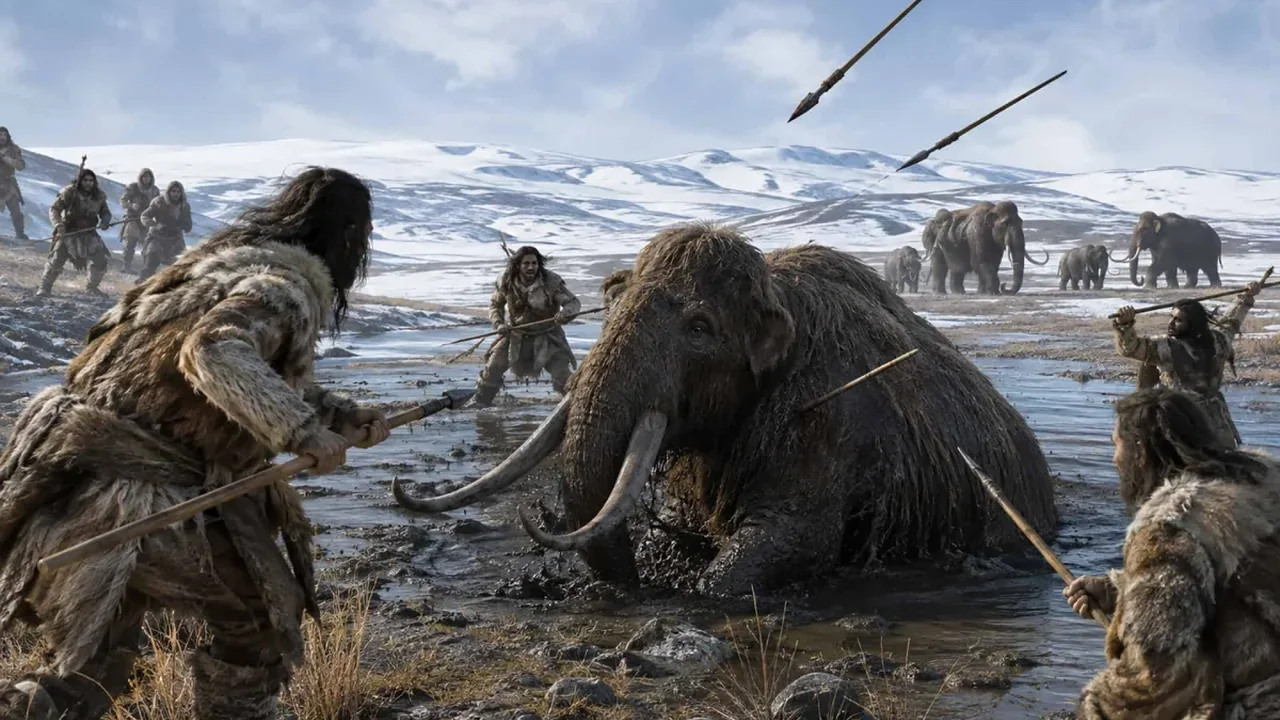
New ancient DNA research is reshaping what we know about Ice Age hunting. By analyzing genomes from 521 woolly mammoths across Eurasia and North America, researchers found a striking pattern: mammoths linked to human activity were mostly female, while those from natural deposits were more often male.
A pattern hidden in the bones
The study compared two sets of remains: 100 mammoths from 11 archaeological sites with signs of human processing, and 421 mammoths from natural deposition sites. The contrast was clear. About 70% of the mammoths associated with people were female, while roughly 66% of the naturally preserved animals were male.
This suggests ancient hunters were not simply collecting carcasses that had already died. Instead, they appear to have repeatedly interacted with female-dominated mammoth groups, likely through targeted hunting or organized procurement.
Why females?
Scientists say the answer may lie in mammoth social behavior. Like modern elephants, woolly mammoths probably lived in family groups led by adult females, while males spent more time alone or in small groups. Those family herds may have followed predictable routes, making them easier to locate. Females protecting calves may also have been less likely to flee quickly, giving hunters more opportunities.
Adult males were larger, reaching about 6 tonnes and standing around 3.4 meters at the shoulder, compared with roughly 4 tonnes and 2.9 meters for females. Even so, the repeated female bias at archaeological sites points to a more complex hunting strategy than size alone.
A rare genetic clue
The research also uncovered an unusual chromosome pattern in a mammoth from Wrangel Island, one of the species' last refuges. The animal showed XX/X0 mosaicism, a rare sex-chromosome condition. It is the first such mutation documented in an extinct species, showing how ancient DNA can now reveal details once thought impossible to detect.
Published in Current Biology, the study adds a new layer to the mammoth story. It strengthens the idea that humans influenced how many mammoth bone accumulations formed, while also showing that climate shifts at the end of the Ice Age likely played a major role in the species' long decline. Together, these findings point to a future where genetics and archaeology can reconstruct prehistoric life with remarkable precision.