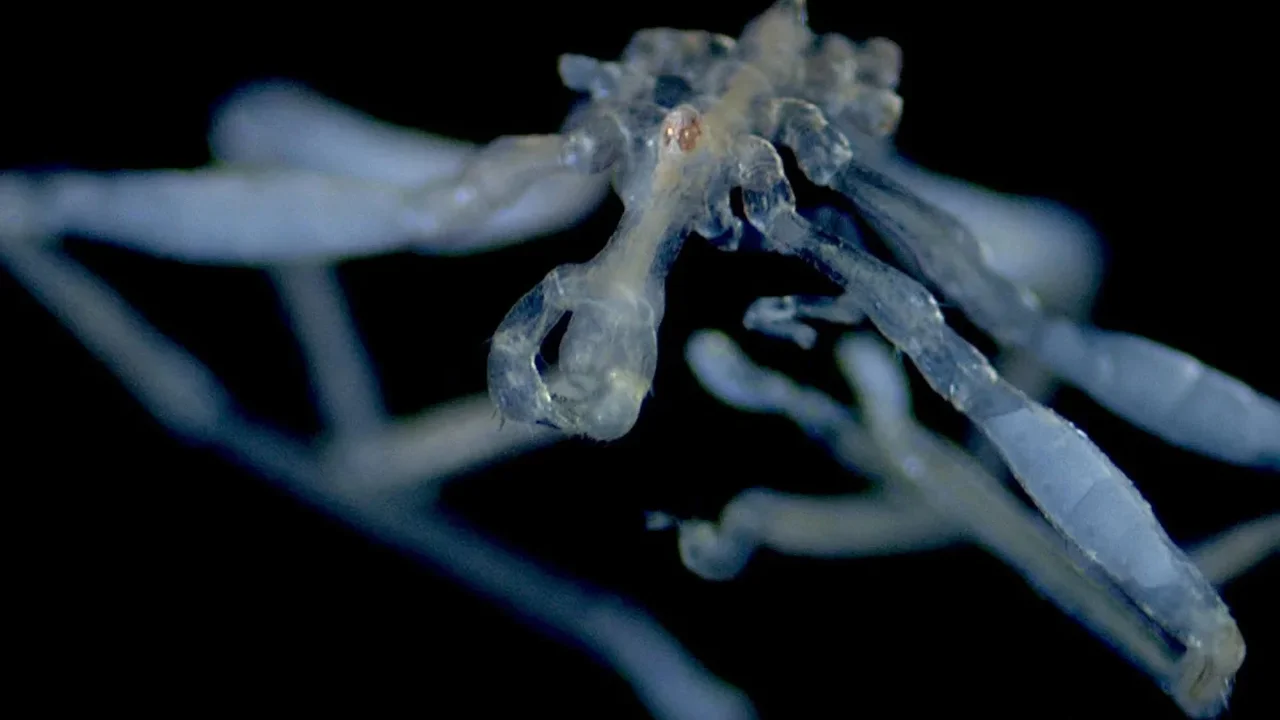
Scientists have described two previously unknown sea spider species from the Salish Sea, the first such discoveries in the region in nearly a century. Their findings add to knowledge of a marine ecosystem whose small, often overlooked inhabitants remain only partly documented.
Sea spiders are not true spiders. They belong to an ancient group of marine arthropods called pycnogonids. Researchers collected specimens during dives at several sites in the northeastern Pacific between September 2023 and August 2024, then examined them using microscopy and DNA analysis. Five other species in the study were already known.
A hairy-legged species with a grooming routine
Callipallene pilosuspedes is named for the long, curved spines on its lower legs. It also has red eyes, specialized claws and a three-lipped mouth. Researchers observed it using its egg-carrying appendages, called ovigers, to comb and clean its own legs.
A miniature ecosystem on another sea spider
The second species, Tanystylum kiixin, lives among hydroids--colonial marine animals related to jellyfish. Researchers found tiny parasites and other material on its body. Its name comes from Kiixin, an Indigenous village site near where the species was first collected.
The discoveries bring attention to how much remains to be learned about the Salish Sea's shallow-water species. Knowing which organisms live in an ecosystem helps researchers track how it changes over time. The study was published in Organisms Diversity & Evolution.
Further surveys may reveal more of the region's hidden marine diversity, strengthening the knowledge needed to understand coastal ecosystems in the years ahead.