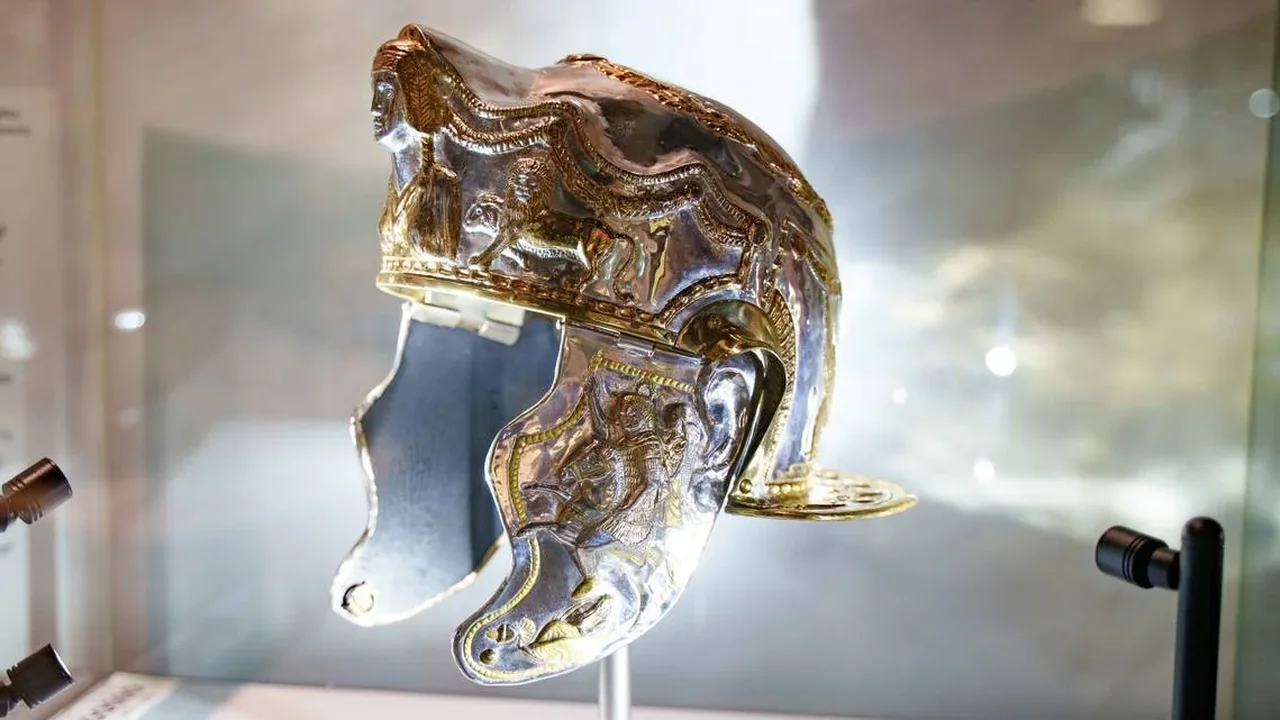
When amateur archaeologists uncovered a heavily corroded object in Leicestershire in the early 2000s, its significance was far from obvious. Examination by the British Museum revealed a Roman cavalry helmet, later named the Hallaton Helmet.
Its surviving fragments include an iron helmet bowl and cheekpieces decorated with traces of gold and silver. The elaborate motifs suggest it belonged to a high-ranking cavalry officer. They include a victory wreath and figures associated with Roman imagery, though parts of the design remain incomplete.
Reconstructing a lost appearance
Conservation work, completed in 2020, stabilized and cleaned the fragments, but corrosion had obscured much of the helmet's original form. Specialists used 3D scans, illustrations and comparisons with Roman art to develop reconstructions--while acknowledging that some details cannot be confirmed.
Two modern replicas offer different interpretations. Rajesh Gogna, a silversmith and senior lecturer at De Montfort University, used digital modelling and contemporary production methods. Archaeologist and replica-maker Francesco Galluccio took a more traditional route, shaping metal using techniques inspired by Roman craftsmanship.
The helmet was found with thousands of Iron Age and Roman coins and other objects at a site believed to have been a shrine. Its purpose there, and the identity of its original owner, remain unknown.
Since March 2024, the original and both replicas have been displayed together at Harborough Museum in Leicestershire. Their contrast makes visible both the limits of preservation and the ways digital tools and skilled craft can help interpret archaeological evidence. Such collaborations can bring the past into clearer view while keeping uncertainty part of the story.