Physical Intelligence, a burgeoning robotics startup based in San Francisco, has recently unveiled groundbreaking research demonstrating that its latest robot brain, π0.7, can autonomously tackle tasks it has never been explicitly trained to perform. This remarkable capability has not only surprised the company's researchers but also marks a significant leap toward developing a general-purpose robotic brain.
The π0.7 model embodies a pioneering approach known as compositional generalization, which allows it to integrate skills learned across various contexts to solve entirely new problems. Traditionally, robotic training has relied heavily on rote memorization, requiring specific data for each task. However, Physical Intelligence asserts that π0.7 transcends this limitation.
Sergey Levine, co-founder of Physical Intelligence and a professor at UC Berkeley, emphasizes that once the model surpasses mere data recall, its capabilities begin to enhance exponentially. This shift mirrors the advancements seen in other fields, such as language processing and computer vision.
One of the most impressive demonstrations involved the robot's interaction with an air fryer, a device it had rarely encountered during training. The model synthesized its limited training experiences and broader pretraining data to understand how to operate the appliance effectively. In a remarkable display, the robot successfully cooked a sweet potato after receiving step-by-step verbal instructions.
This coaching ability suggests that robots could be deployed in unfamiliar environments and learn in real-time without needing extensive retraining or data collection. However, the team is cautious about overstating their findings, acknowledging the challenges in validating their model's performance against standardized benchmarks.
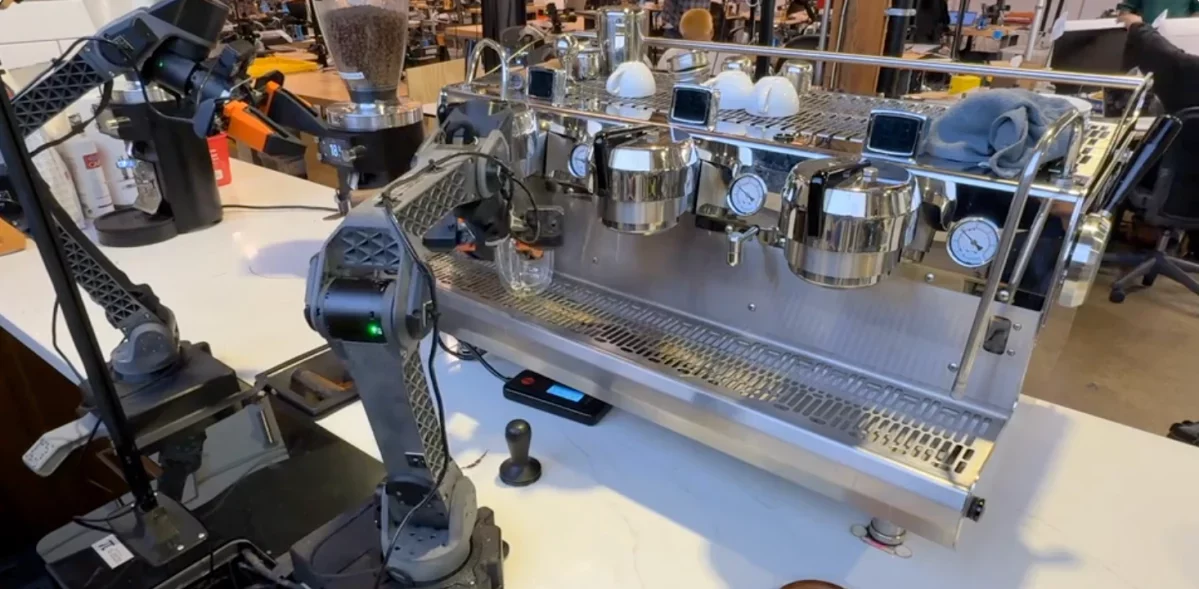
Physical Intelligence's research indicates that π0.7 matches the performance of previous specialist models in complex tasks such as making coffee and folding laundry. What sets this development apart is the unexpected results that have astonished even the researchers who meticulously understand the training data.
Levine recalls the excitement of witnessing the robot's unexpected success when tasked with rotating a gear set, a moment reminiscent of early breakthroughs in language models. While critics may point out that robotic tasks can seem less thrilling compared to grand demonstrations, the focus on genuine generalization is what makes this advancement truly significant.
Despite the promising results, the team remains realistic about the limitations of the model, which still requires guided instructions for multi-step tasks. As they continue to refine their technology, Physical Intelligence has raised over $1 billion in funding and is currently valued at $5.6 billion, with discussions underway for a new round of investment that could elevate its valuation to $11 billion.
As the field progresses, the potential for robots equipped with π0.7 to adapt and learn in real-time could transform how we integrate robotics into daily life, paving the way for a future where machines can seamlessly assist in various tasks.