In various industrial sectors, the separation of substances is crucial for processes such as drug purification, textile dye treatment, and food production. Despite its importance, these separation methods are among the most energy-demanding, consuming approximately 40% to 50% of global industrial energy.
Traditionally, industries have relied on techniques like distillation and evaporation. While effective, these methods are energy-intensive and contribute significantly to carbon emissions. Membrane-based filtration is emerging as a cleaner alternative, yet conventional polymer membranes often feature unevenly sized pores that can degrade over time, limiting their effectiveness in challenging industrial settings.
Innovative POMbranes with Nanometer-Scale Precision
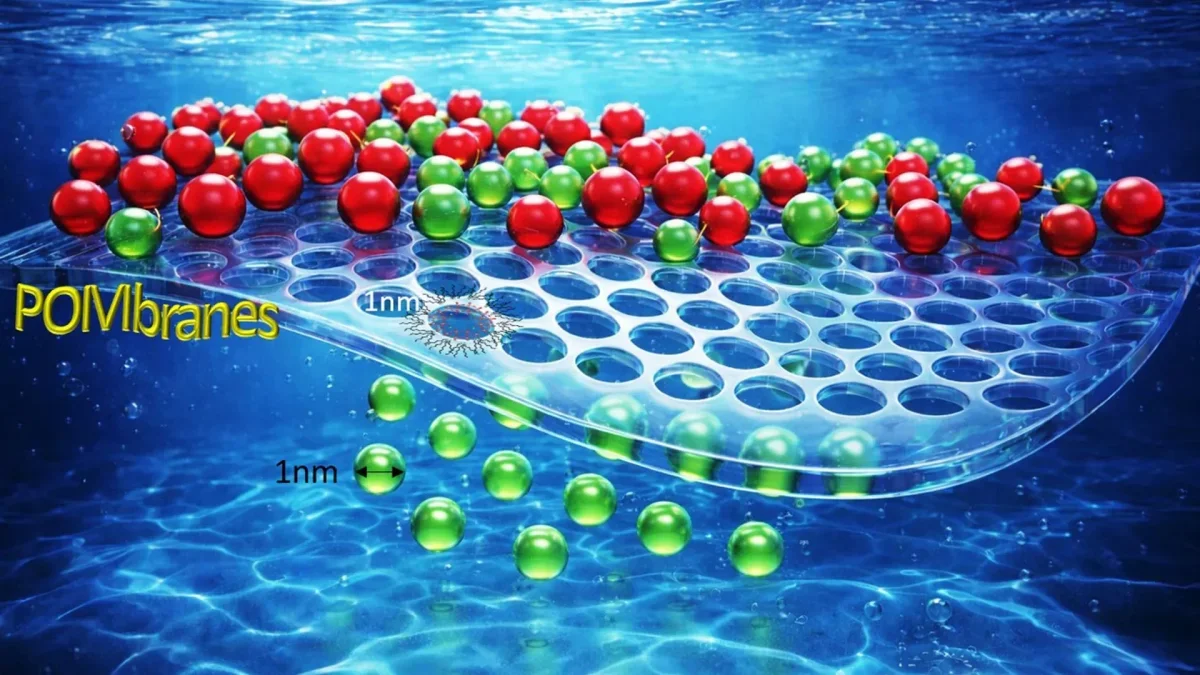
To overcome these challenges, researchers have developed a groundbreaking class of ultra-selective membranes known as "POMbranes." Dr. Shilpi Kushwaha, a Senior Scientist at CSMCRI, explains that these membranes possess pores measuring just one nanometer in width--thousands of times thinner than a human hair.
These membranes draw inspiration from biological systems, such as aquaporins, which control molecular movement through precisely sized channels. By utilizing polyoxometalate (POM) clusters, each featuring a stable, one-nanometer opening, the researchers have achieved remarkable consistency.
Ms. Priyanka Dobariya, a co-first author of the research, highlights that these crown-shaped metal clusters maintain a permanent hole, addressing a significant limitation of traditional plastic filters.
Creating a Continuous Ultrathin Membrane
The practical application of these membranes required the arrangement of billions of these tiny structures into a seamless layer. Researchers successfully attached flexible chemical chains to the POM clusters, enabling them to self-organize into a large-area ultrathin film when placed in water. By adjusting the chain lengths, the team could control the packing density of the clusters.
Dr. Raghavan Ranganathan from IITGN's Department of Materials Engineering noted that this configuration forces molecules to navigate through the exclusive one-nanometer openings, turning the membrane into a sophisticated sieve.
Exceptional Separation Capabilities
Testing has revealed that these membranes can effectively differentiate between molecules with a mere 100-200 Dalton difference, a level of precision rarely achieved with conventional polymer membranes.
Dr. Ketan Patel, Principal Scientist at CSMCRI, emphasizes the potential for these membranes to foster sustainable manufacturing practices, boasting nearly ten times better separation performance compared to existing technologies while remaining flexible, stable, and scalable.
Impact on Textile and Pharmaceutical Industries
This innovative technology holds particular promise for India's textile and pharmaceutical sectors, which are vital to the nation's economy. The textile industry alone contributes over 2.3% of GDP and is projected to grow significantly in the coming years. The membranes can efficiently remove dye molecules from wastewater, facilitating water reuse and reducing environmental impact.
In pharmaceutical manufacturing, precise separations are essential for maintaining product quality. Mr. Vinay Thakur notes that these membranes can significantly reduce energy consumption while adhering to stringent industry standards.
A Versatile Solution for Future Manufacturing
The POMbranes represent a versatile platform technology, adaptable for a wide range of industrial separation tasks, from wastewater treatment to advanced chemical processes. As industries increasingly prioritize efficiency and sustainability, these molecularly engineered membranes could play a crucial role in shaping the future of manufacturing.