A remarkable discovery has been made in the cosmos: a hidden galaxy named CDG-2, which may be one of the most dark matter-dominated galaxies ever observed. This intriguing finding was detailed in The Astrophysical Journal Letters.
Unveiling CDG-2
Detecting such faint galaxies presents significant challenges. Astronomer David Li from the University of Toronto and his team employed sophisticated statistical methods to uncover clues. Instead of focusing on dim starlight, they sought out compact groupings of globular clusters--dense, spherical collections of stars that orbit galaxies. These clusters serve as indicators, suggesting the presence of a faint galaxy nearby.
Through this innovative approach, the researchers identified ten previously recognized low-surface-brightness galaxies, along with two additional candidates for dark galaxies.
Verification via Hubble, Euclid, and Subaru
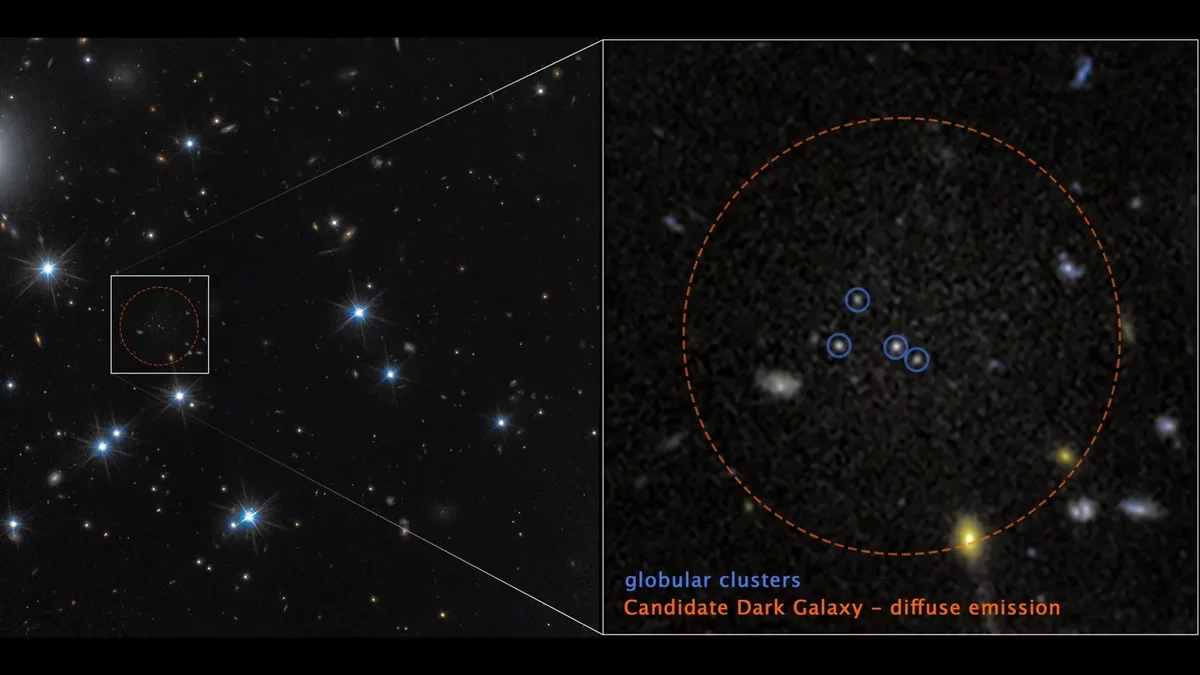
To confirm one candidate, astronomers utilized three powerful observatories: NASA's Hubble Space Telescope, the European Space Agency's Euclid space observatory, and the Subaru Telescope in Hawaii. High-resolution images from Hubble revealed four tightly clustered globular clusters within the Perseus galaxy cluster, located 300 million light-years from Earth.
Combining data from Hubble, Euclid, and Subaru, the team discovered a faint halo of light surrounding the clusters. This subtle glow provided compelling evidence of an underlying galaxy's existence.
"This marks the first detection of a galaxy based solely on its globular cluster population," stated Li. "Under conservative assumptions, these four clusters represent the complete globular cluster population of CDG-2."
A Galaxy Primarily Composed of Dark Matter
Initial measurements suggest that CDG-2 emits light equivalent to that of approximately 6 million Sun-like stars. Notably, the four globular clusters contribute to 16% of the visible light in the galaxy, while an astonishing 99% of its total mass, including both visible and dark matter, appears to be dark matter.
Much of the hydrogen gas typically required for star formation was likely stripped away due to gravitational interactions with other galaxies within the densely populated Perseus cluster.
Globular clusters are extremely dense and gravitationally bound, enabling them to endure tidal disruptions. This characteristic makes them reliable indicators of faint and elusive galaxies like CDG-2.
The Future of Dark Matter Searches
As extensive sky surveys continue through missions such as Euclid, NASA's forthcoming Nancy Grace Roman Space Telescope, and the Vera C. Rubin Observatory, researchers increasingly leverage machine learning and advanced statistical techniques to analyze vast data sets.
With over 30 years of operation, the Hubble Space Telescope remains a pivotal tool in astronomical research. Jointly managed by NASA and the European Space Agency, it continues to facilitate groundbreaking discoveries.