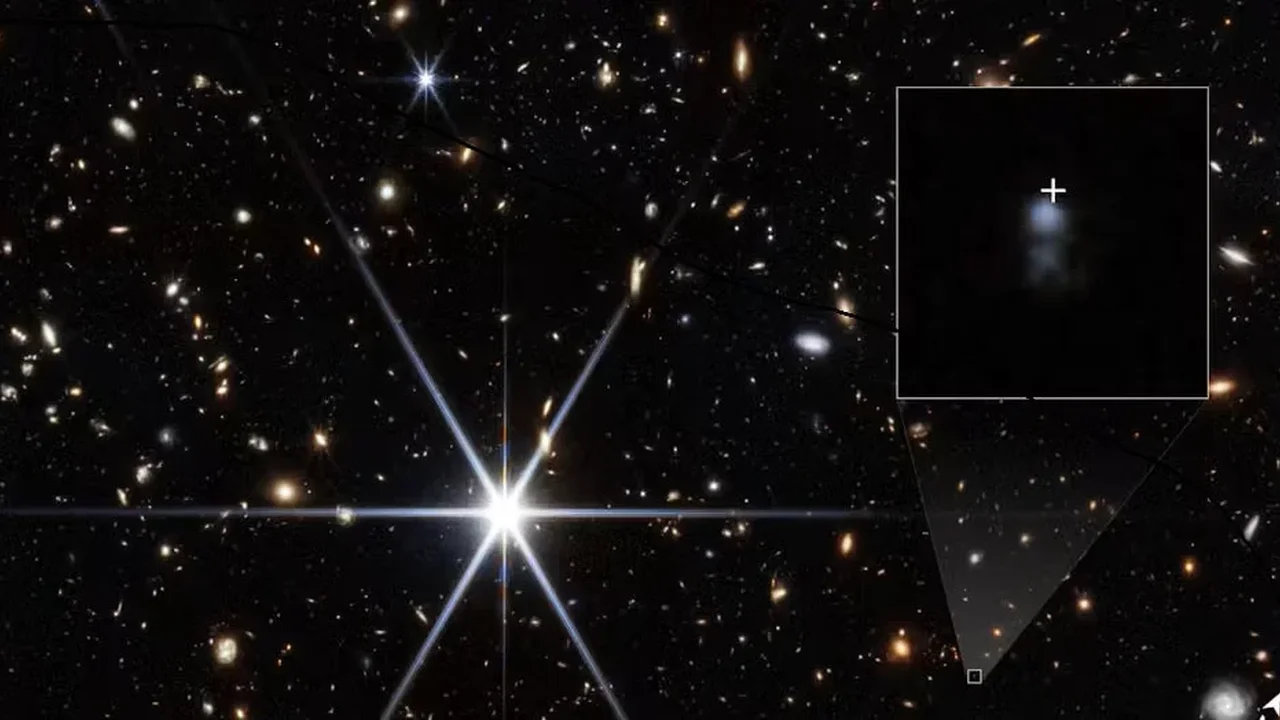
In a remarkable discovery, the Webb Space Telescope has identified a giant galaxy, designated XMM-VID1-2075, that exhibits no signs of rotation. This finding, detailed in a recent study led by Ben Forrest from the University of California, Davis, challenges existing theories about galaxy formation and behavior.
Typically, galaxies are expected to spin as they develop. This rotation is a result of gas flowing inward and the gravitational forces at play, which generate angular momentum. Over eons, galaxies can collide and merge, leading to complex interactions that may either enhance or diminish their rotational dynamics. The fact that XMM-VID1-2075 shows such characteristics at a time when the universe was less than 2 billion years old is particularly intriguing.
Insights from the MAGAZ3NE Survey
Forrest and his team, part of the MAGAZ3NE (Massive Ancient Galaxies at z>3 NEar-Infrared) survey, previously utilized the W.M. Keck Observatory in Hawaiʻi to study this galaxy. They found it to be one of the most massive galaxies from the early universe, possessing several times the number of stars compared to our Milky Way. Notably, it has ceased forming new stars, making it an ideal candidate for further analysis.
Using the advanced capabilities of the James Webb Space Telescope, researchers analyzed XMM-VID1-2075 alongside two other contemporaneous galaxies. This allowed them to observe internal motions within these systems. As Forrest noted, while studies of nearby galaxies are common, analyzing distant, high redshift galaxies poses significant challenges due to their diminished visibility.
Among the trio of galaxies examined, one exhibited clear rotation, another had an irregular structure, while XMM-VID1-2075 displayed no rotation but significant random stellar motion. This observation aligns with characteristics seen in massive galaxies closer to Earth, yet discovering such a phenomenon in the early universe is unexpected.
Understanding the Lack of Rotation
Researchers are now investigating how XMM-VID1-2075 became a "slow rotator" so rapidly. One hypothesis suggests that rather than a history of multiple mergers, a singular, impactful collision could be responsible. If two galaxies with opposing spins collided, their rotational motions could effectively cancel each other out.
Forrest highlighted an intriguing aspect of this galaxy: an excess of light detected off to the side, indicating potential interactions with another object that may be altering its dynamics.
Future Exploration of Non-Rotating Galaxies
The team is eager to identify more galaxies like XMM-VID1-2075 in the early universe. By comparing these observations with computer simulations, scientists aim to validate current theories surrounding galaxy formation. While some models predict a scarcity of non-rotating galaxies from this period, this research could provide vital insights into the evolution of galaxies and the underlying mechanics of the cosmos.
With continued exploration and advancements in technology, our understanding of the universe's early structures and their behaviors is set to expand, potentially reshaping our comprehension of cosmic evolution.