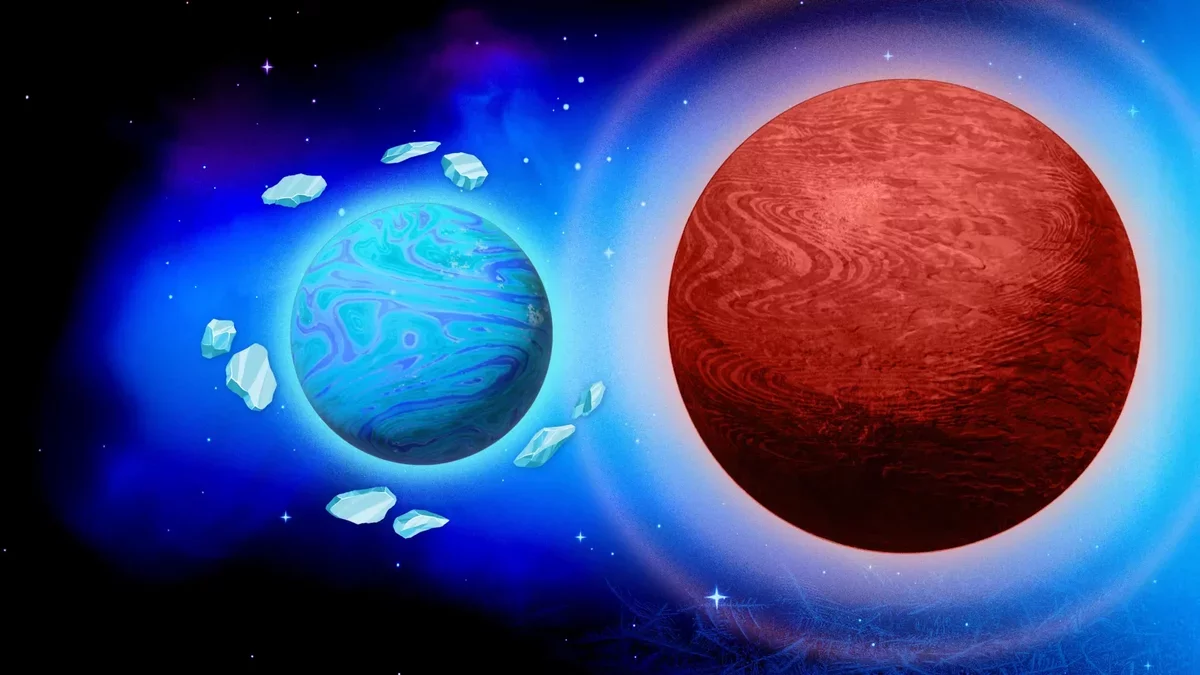
Researchers from MIT have recently delved into the atmosphere of a peculiar planetary duo, revealing insights into their formation that challenge existing theories.
Insights from the James Webb Space Telescope
In a groundbreaking study featured in the Astrophysical Journal Letters, the team utilized NASA's James Webb Space Telescope (JWST) to scrutinize the atmosphere of a mini-Neptune situated within the orbit of a hot Jupiter. This marks a significant milestone as it is the first instance of scientists measuring the atmospheric composition of such a mini-Neptune.
The analysis unveiled that the planet's atmosphere is unexpectedly dense, containing heavier molecules like water vapor, carbon dioxide, sulfur dioxide, and traces of methane. Such an atmospheric profile is unusual for a planet believed to have formed near its star, where lighter gases typically prevail.
Formation Beyond the Frost Line
The findings suggest that both the mini-Neptune and the hot Jupiter likely originated much farther from their star, in a cooler region of the early gas and dust disk surrounding it. In this environment, icy materials and volatile compounds could gather more readily, enabling the planets to develop thicker atmospheres.
Over time, the duo likely migrated inward towards their star while retaining their atmospheres and maintaining their distinctive orbital configuration. This research provides compelling evidence that mini-Neptunes can form beyond a star's "frost line," the threshold where temperatures are low enough for water to freeze into ice.
"This is the first time we've observed the atmosphere of a planet that is inside the orbit of a hot Jupiter," stated Saugata Barat, a postdoctoral researcher at MIT's Kavli Institute for Astrophysics and Space Research and the lead author of the study. "This measurement confirms that this mini-Neptune indeed formed beyond the frost line, validating this formation channel."
The collaborative effort included scientists from various esteemed institutions, such as MIT, the Harvard and Smithsonian Center for Astrophysics, the University of South Queensland, the University of Texas at Austin, and Lund University.
A Unique Planetary Configuration
Mini-Neptunes, smaller than Neptune, are primarily composed of gas surrounding a rocky core and are the most prevalent type of planet in the Milky Way, despite their absence in our solar system.
In 2020, Chelsea X. Huang, then a postdoctoral fellow at MIT, identified this intriguing system, where the mini-Neptune orbits alongside a hot Jupiter, a rare occurrence in astronomy.
Utilizing data from NASA's Transiting Exoplanet Survey Satellite (TESS), the team studied a star designated TOI-1130 and confirmed the existence of both planets. The mini-Neptune completes an orbit every four days, while the hot Jupiter takes eight days.
"This was a one-of-a-kind system," remarked Huang. "Hot Jupiters are typically 'lonely' and do not have companion planets within their orbits due to their immense gravity. However, this hot Jupiter has managed to retain an inner companion, prompting questions about the formation of such a system."
Challenges in Observation
The discovery led to further investigation using JWST to analyze the inner planet, TOI-1130b. Observing this planet posed challenges due to its unique orbital behavior, referred to as "mean motion resonance," where each planet's gravity influences the other's orbit.
To navigate this complexity, Judith Korth of Lund University led a team that compiled prior observations to forecast when the planets would pass in front of their star for JWST to observe.
Revealing Planetary Chemistry
Once the timing was accurate, JWST provided detailed data across various wavelengths of light. "The beauty of JWST lies in its ability to observe across different wavelengths, revealing much about the atmospheric composition," Barat explained.
The data highlighted significant signatures of water, carbon dioxide, and sulfur dioxide, alongside smaller amounts of methane, contrasting with the lighter gases typically found in planets that form close to their stars. This discovery challenges prior assumptions and supports the notion that TOI-1130b originated much farther out before migrating inward.
Implications for Planetary Migration
The planet likely accumulated its atmosphere in a cold region beyond the frost line, where water freezes onto dust, forming icy particles. As it migrated inward, the ice would have evaporated, resulting in the thick atmosphere observed today.
Barat added that the presence of these heavier molecules reinforces the idea that both planets likely formed in the outer regions of their system and migrated inward together while preserving their atmospheres. "This system represents one of the rarest planetary architectures discovered," he noted. "The observations of TOI-1130b provide the first indication that mini-Neptunes forming beyond the water/ice line exist in nature."
This research was partly supported by NASA, highlighting the collaborative efforts that continue to expand our understanding of planetary formation.