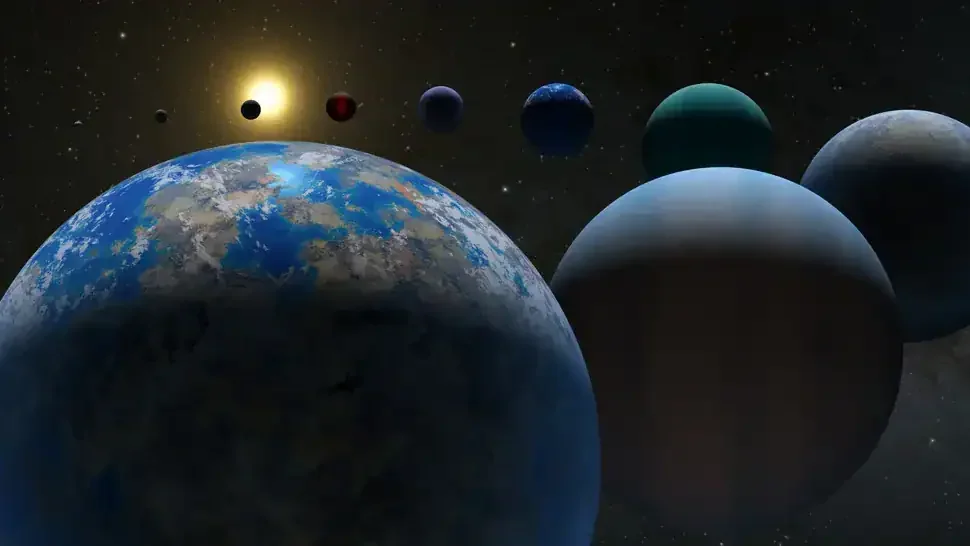
A significant discovery has emerged from NASA's archives, revealing a wealth of potential planets hidden within existing data. Researchers have reexamined the first year of observations from NASA's Transiting Exoplanet Survey Satellite (TESS) and identified an astonishing 11,554 planet candidates. Notably, 10,091 of these candidates were previously unrecognized.
Expanding Horizons
TESS detects planets by monitoring the dimming of stars. This phenomenon occurs when a planet transits in front of its star, blocking a minute portion of the light. However, the challenge lies in distinguishing genuine transits from noise caused by various factors, including other stars or spacecraft patterns. Traditionally, researchers have focused on brighter stars, where follow-up observations can be more straightforward.
"We broadened our search to include fainter stars, which have been overlooked in previous studies," explained Joshua Roth, a graduate researcher at Princeton University and the study's lead author. This strategic shift opened up a treasure trove of data, as the team analyzed over 83 million records of starlight from TESS's initial year.
Innovative Detection
Utilizing a semi-automated pipeline powered by machine learning, the researchers implemented a random forest classifier to sift through the data. This system allows multiple decision trees to evaluate whether a signal corresponds to a planet, an eclipsing binary star system, or merely noise. Roth emphasized the advantages of this approach: "This significantly enlarges our pool of stars to search for planets."
The researchers tailored their models for both bright and faint stars, acknowledging that faint stars produce different noise patterns. After filtering the data, the team manually inspected around 50,000 potential transit signals, ensuring that each candidate underwent rigorous human vetting.
This new catalog serves as a roadmap for future investigations. While some candidates may ultimately prove to be false alarms, the sheer scale of the findings is remarkable--over 6,000 exoplanets have been confirmed in the last three decades, and this study adds more than 10,000 new possibilities from just one year of TESS data.
The majority of these candidates are classified as gas giants, with a small fraction resembling Neptunes and super-Earths. Among them are 66 ultra-short-period candidates, potentially completing their orbits in less than a day.
Confirming Discoveries
To validate their findings, the researchers focused on one specific target: TIC 183374187. Using the Planet Finder Spectrograph on the Magellan Clay Telescope in Chile, they confirmed this candidate as TIC 183374187 b, a hot Jupiter that orbits every 5.059 days.
Looking Ahead
The first year of TESS observations primarily targeted the southern sky, marking just the beginning of this extensive catalog. Roth and his team are now delving into TESS's second year of observations, which includes revisiting previously studied stars and expanding their search methodology.
As they continue to refine their techniques, the focus will shift from discovery to prioritizing which candidates warrant further investigation. This groundbreaking research not only enhances our understanding of planetary systems but also sets the stage for future explorations of the cosmos.
This development signifies a pivotal moment in exoplanet research, potentially reshaping our understanding of the universe and the formation of planetary systems.