Nature seldom adheres to straight lines. Observing a forest, a rock formation, or a coastline reveals a myriad of irregular shapes and chaotic patterns. However, if you venture to the coasts of Northern Ireland or the arid deserts of Oregon, you might encounter structures that appear almost engineered.
These structures are known as columnar basalt.
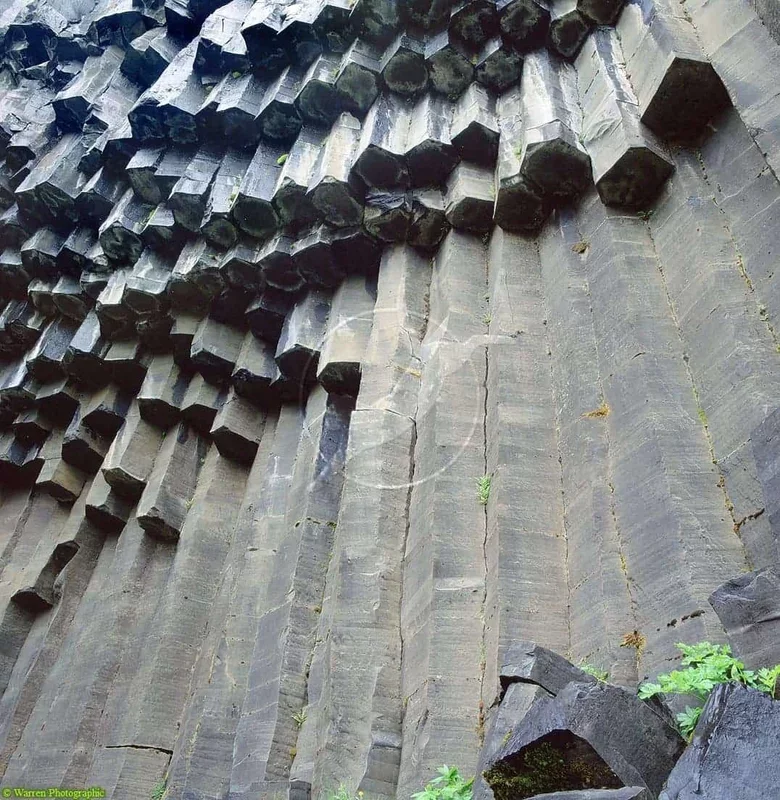
Massive, dark stone pillars emerge from the earth, exhibiting a striking hexagonal shape. They stand closely together, reminiscent of an army of petrified lava formations. While they may seem sculpted by human hands, they are entirely natural. These columns represent the Earth's ingenious solution to a complex physics challenge under considerable pressure.
A Volcanic Eruption
Basalt originates as fluid, extremely hot lava, typically ranging from 1,100°C to 1,250°C. The higher the temperature, the more fluid the lava becomes. As basaltic lava flows, it can pool in a valley, forming a thick lake of molten rock that cools from both the top and bottom.
As the lava loses heat, it solidifies and shrinks, initiating a fascinating process.
When cooling occurs, the lava begins to pull apart from itself in all directions, generating significant internal stress. To alleviate this pressure, the rock must crack, and physics dictates that it does so in the most efficient manner possible.
Initially, these cracks may appear random, but as cooling progresses deeper into the flow, they become more organized. Nature tends to favor efficiency; thus, the lava adopts a pattern of 120-degree angles.
Why specifically 120 degrees? This angle corresponds to that of a hexagon. Using circles to cover a surface results in gaps, while squares leave weak corners. Hexagons, however, fit together seamlessly without any wasted space. This is also the reason bees construct hexagonal honeycombs; it is the most energy-efficient design.
As the cooling front advances into the core of the lava, these cracks follow suit, segmenting the rock into elongated vertical columns.
But Why Are They Vertical?
The columns grow perpendicular to the cooling surface. If the lava forms a flat lake, the heat dissipates from the top, leading to vertical growth. However, nature is seldom flat. When lava flows into a curved valley, the columns twist and bend to adapt to the temperature variations. For instance, at Svartifoss in Iceland, the columns resemble organ pipes cascading over a cliff.
These formations also serve as ancient thermometers. By analyzing the diameter of the columns, geologists can determine the rate at which the lava cooled. Wider columns indicate a stable cooling process over an extended period, while thinner columns suggest rapid and chaotic cooling.
Columnar basalt can be found in various locations, requiring the right volcanic eruption and cooling conditions. In the United States, Devils Tower in Wyoming stands as an 800-foot monolith that resembles a cluster of petrified straws. For the Lakota and other Plains tribes, this site holds sacred significance, attributed to the legend of a giant bear clawing at a mountain. Observing the vertical grooves makes the "bear scratch" narrative quite believable.
Yet, it wasn't bears or giants that crafted these formations; it was the fundamental laws of thermodynamics. And honestly, that's a far more compelling tale.
This article has been edited to include additional information.