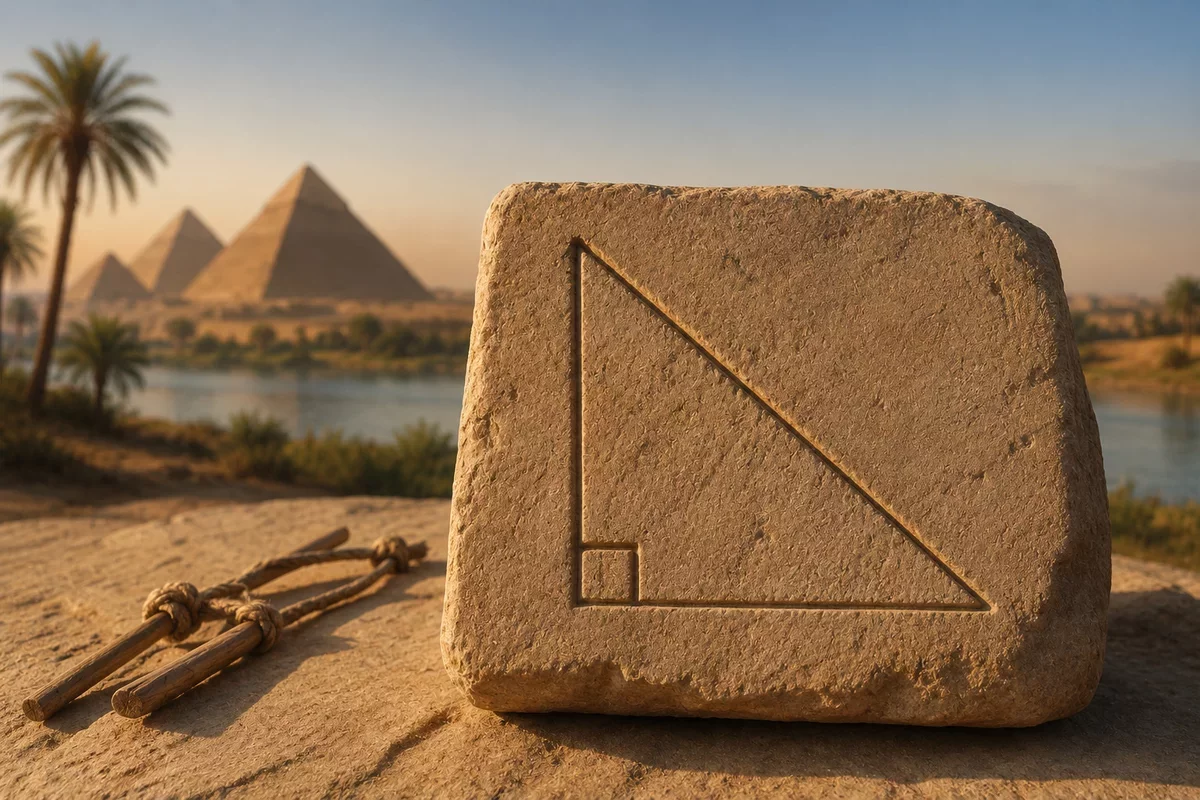
The Pythagorean theorem, commonly attributed to the Greek philosopher Pythagoras, is often celebrated as one of the fundamental principles of mathematics. However, recent archaeological findings reveal that this theorem was in use long before Pythagoras' time, with ancient civilizations such as the Babylonians, Egyptians, Indians, and Chinese employing the right-triangle principle centuries earlier.
Typically expressed as a² + b² = c², where 'c' represents the hypotenuse, this theorem has been integral in various applications, from surveying and construction to astronomy. It provided a systematic way to calculate distances and angles, enabling builders and surveyors to create stable structures and accurately measure land.
Exploring Historical Context
Pythagoras, who lived in the sixth century BCE, founded a philosophical community in Croton, Italy, where he emphasized the significance of numbers. Despite his contributions, no written works by Pythagoras have survived, leading to questions about his direct association with the theorem.
While Greek and Roman authors linked Pythagoras to this theorem, it was Euclid, another eminent Greek mathematician, who offered the first documented proof in his influential work, Elements, around 300 BCE. This textbook has shaped mathematical education for over two millennia.
Evidence from Ancient Civilizations
Notably, the Plimpton 322 tablet from Babylon, dating back to approximately 1800 BCE, lists Pythagorean triples, suggesting that Babylonian mathematicians were well-versed in these relationships. Similarly, ancient Egyptian texts demonstrate their practical use of geometry in land measurement and architecture, showcasing their advanced understanding of right triangles.
Furthermore, India's Sulba Sutras and China's gougu theorem also reflect knowledge of this mathematical relationship, indicating a widespread understanding across cultures. The Sulba Sutras provide explicit instructions for constructing right triangles, while the Zhoubi Suanjing from China includes visual proofs of the theorem.
The Legacy of the Theorem
While the theorem is commonly known as the Pythagorean theorem, its historical roots extend far beyond Pythagoras. The acknowledgment of its diverse origins enriches our understanding of mathematics as a collaborative and evolving discipline. As we continue to explore these ancient mathematical practices, we gain insights into the interconnectedness of human knowledge across cultures and time.
Looking ahead, embracing this broader historical context may inspire future generations to appreciate the rich tapestry of mathematical discovery and its impact on our world.