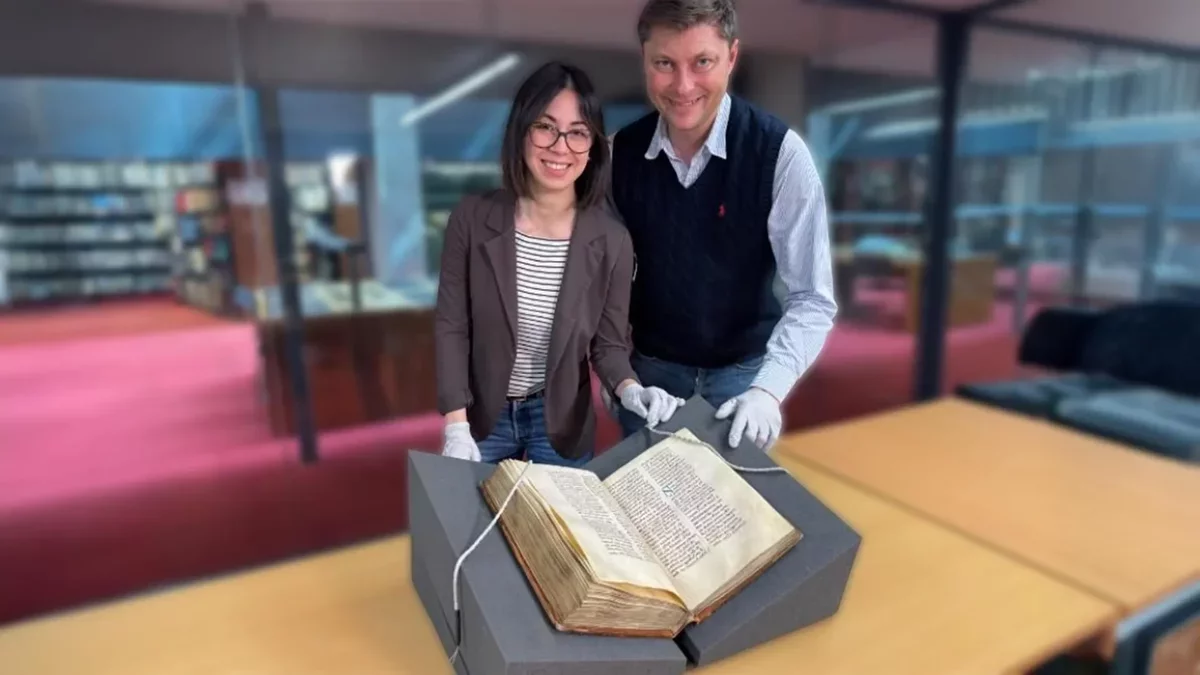
A remarkable discovery has emerged from the National Central Library of Rome, where a manuscript containing Caedmon's Hymn, the earliest known poem in English, has been identified. This manuscript, dating back to between 800 and 830 AD, is now recognized as the third oldest surviving version of the poem, which was composed over 1,300 years ago.
What sets this manuscript apart is its unique presentation of the poem. Unlike the two earlier copies found in Cambridge and St Petersburg, where the Old English verses were added in the margins or at the end of the Latin text, the Rome manuscript integrates the Old English lines directly within the main text. This indicates a profound appreciation for Old English poetry among early medieval readers, as noted by scholars from Trinity College Dublin.
Understanding Caedmon's Hymn
Caedmon's Hymn consists of nine lines that celebrate the creation of the world, originally composed in Old English, the vernacular of early medieval England. The poem's survival can be attributed to its inclusion in manuscripts of Ecclesiastical History of the English People, authored by the monk Bede in the 8th century.
This newly uncovered manuscript was brought to light by Dr. Elisabetta Magnanti and Dr. Mark Faulkner, who published their findings in the journal Early Medieval England and its Neighbours by Cambridge University Press. Dr. Magnanti expressed her excitement upon confirming the manuscript's existence and discovering the embedded Old English version of the hymn.
Significance of the Discovery
This find provides invaluable insight into the early history of written English. Dr. Faulkner emphasized that while around three million words of Old English exist, most texts date from the 10th and 11th centuries. Caedmon's Hymn, as a 7th-century poem, serves as a crucial link to the origins of English literature. The manuscript illustrates how early readers valued the original Old English, as it was reinserted into the Latin text shortly after Bede's work.
A Manuscript's Journey
This manuscript, one of at least 160 copies of Bede's History, originated from the Abbey of Nonantola in Italy. It has a storied past, having been relocated for safekeeping during the Napoleonic Wars, later stolen, and eventually acquired by the National Central Library of Rome. Its importance was overlooked until digitization efforts brought it back into the academic spotlight.
Valentina Longo, Curator of Mediaeval and Modern Manuscripts at the library, highlighted the extensive digitization project that has made a wealth of historical manuscripts accessible to researchers worldwide.
The Legend of Caedmon
According to legend, Caedmon was a humble cowherd who, inspired by a divine vision, composed this hymn, marking a significant moment in the history of English literature. The manuscript's rediscovery reignites interest in the Abbey of Nonantola and its contributions to cultural heritage.
As Canon Dr. Riccardo Fangarezzi noted, this manuscript enriches the Anglo-Nonantolan cultural treasury and symbolizes the enduring legacy of early English poetry. Such discoveries illuminate the path forward for research and cultural appreciation, reminding us of the light that knowledge can bring to even the darkest of times.