Archaeological findings reveal that 15,000 years ago, ancient communities were shaping clay into ornaments, a practice that highlights the early development of creativity and social interaction. This groundbreaking study challenges the traditional view that symbolic uses of clay emerged only with the advent of agriculture.
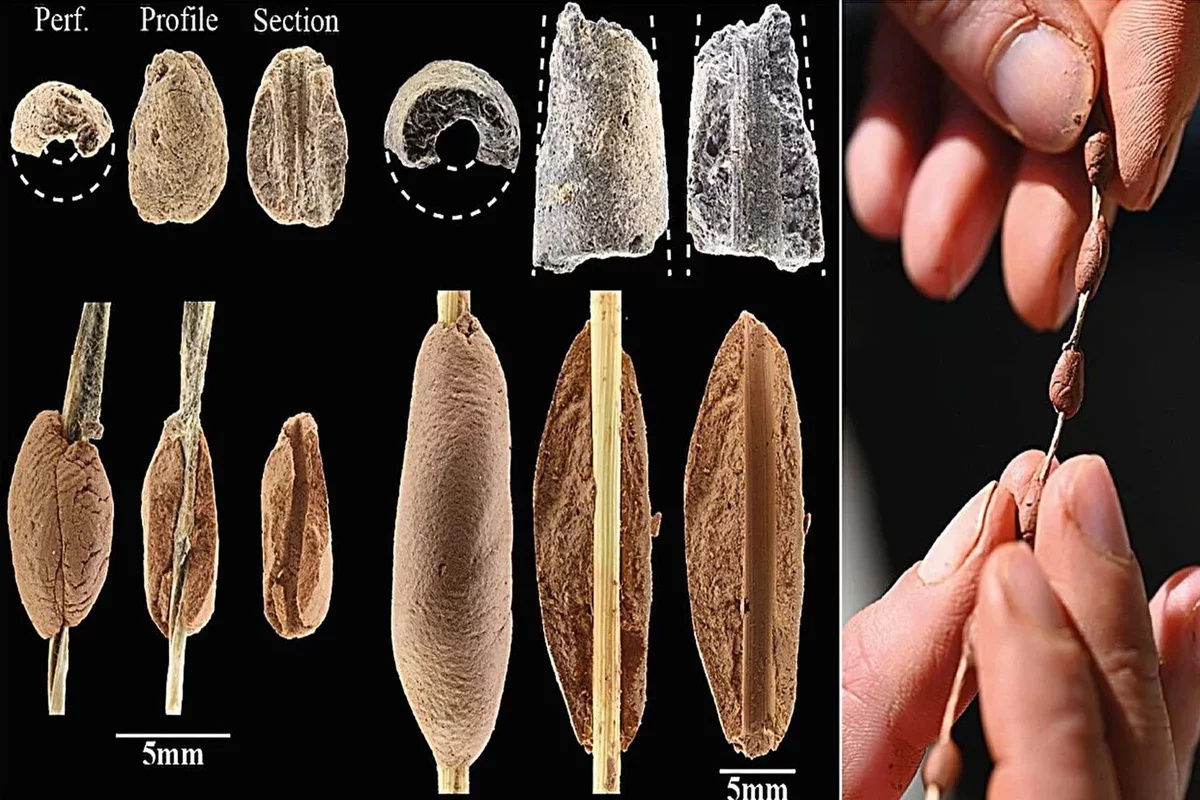
Researchers analyzed 142 clay beads and pendants from four prehistoric sites in modern-day Israel, associated with the Natufian culture, a group of hunter-gatherers known for early settlement. The artifacts, crafted from unfired clay, showcase various shapes resembling plants that were crucial for survival, indicating that these early communities were not only utilizing plants for sustenance but also incorporating them into their cultural identity.
Among the discoveries were traces of plant fibers, suggesting that these beads were worn as ornaments. The use of red pigment on some pieces demonstrates that even at this early stage, there was an interest in decoration and refinement.
"Clay, it turns out, had already become a medium for visual communication long before it was used for bowls or jars. This discovery completely changes how we understand the relationship between clay, symbolism, and the emergence of settled life," stated Laurent Davin, the study's lead author from Hebrew University of Jerusalem.
Notably, the presence of approximately 50 preserved fingerprints indicates that children were actively involved in the crafting process, marking a significant shift in our understanding of social dynamics in early human life. For instance, a small bead shows evidence of being pinched by a child, while a tiny ring appears to have been made for a child to wear.
This suggests that bead-making was a communal activity, fostering learning and creativity among all ages. The variety and number of artifacts indicate that working with clay was a well-established practice, rather than a sporadic experiment.
The implications of these findings extend beyond mere ornamentation; they push back the timeline of symbolic clay use and suggest that social and cognitive advancements were already underway in human communities long before the rise of agriculture. This insight reshapes our understanding of how early humans began to view themselves and their environment.
"These findings offer original insights into the social organization of craft production and the rise of symbolic practices at the dawn of sedentism, which ultimately shaped the Neolithic transition in Southwest Asia," the authors noted.
Future research aims to explore similar artifacts from other regions to gain a broader understanding of this ancient practice. As we uncover more about our ancestors, we gain insights into the foundational aspects of human culture that continue to influence us today.