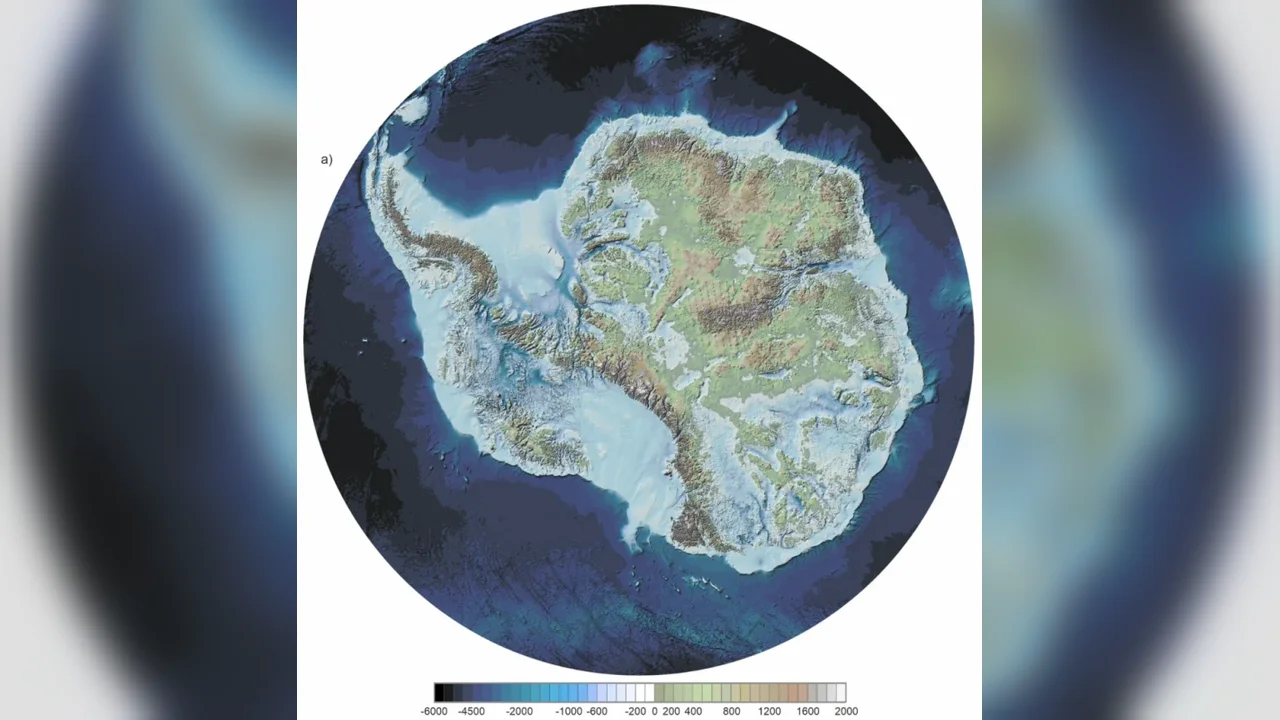
Antarctica's frozen surface has long concealed a complex world of valleys, ridges, canyons, and subglacial lakes. Now, a new map called Bedmap3 offers the clearest view yet of the continent's land beneath the ice, showing Antarctica as if its massive ice cover had disappeared.
A sharper view of the southern continent
Built from more than six decades of observations, Bedmap3 brings together data gathered by aircraft, satellites, ships, and even sled-based fieldwork. An international research team added 84 new aerial surveys, 52 million data points, and 1.9 million line-kilometers of measurements to refine the picture.
The map uses advanced modeling to fill in areas where direct measurements were missing, especially in regions with thin ice or difficult terrain. The result is a far more precise representation of Antarctica's hidden bedrock, particularly across East Antarctica's interior and the West Antarctic coast.
According to British Antarctic Survey glaciologist Dr. Hamish Pritchard, this kind of detail is essential for understanding how ice moves across uneven ground. The shape of the land below the ice helps determine where glaciers slow down, where they accelerate, and how they respond to rising temperatures.
One of the map's most striking findings is the location of Antarctica's thickest ice. Earlier estimates pointed to one basin in Adélie Land, but Bedmap3 identifies a canyon in Wilkes Land where the ice reaches 4,757 meters thick. The map also highlights newly defined zones where floating ice shelves temporarily touch the seabed during low tides.
These details matter because Antarctica holds enough ice to raise global sea levels by about 58 meters if it were ever to melt completely. While that scenario is not imminent, the new map improves the models scientists use to study ice flow and long-term stability.
Published in Scientific Data, Bedmap3 marks a major step forward in polar science. As mapping technology continues to improve, future research may reveal even more about the continent's hidden structure and its role in Earth's climate system. That knowledge could shape more accurate predictions for the decades ahead.