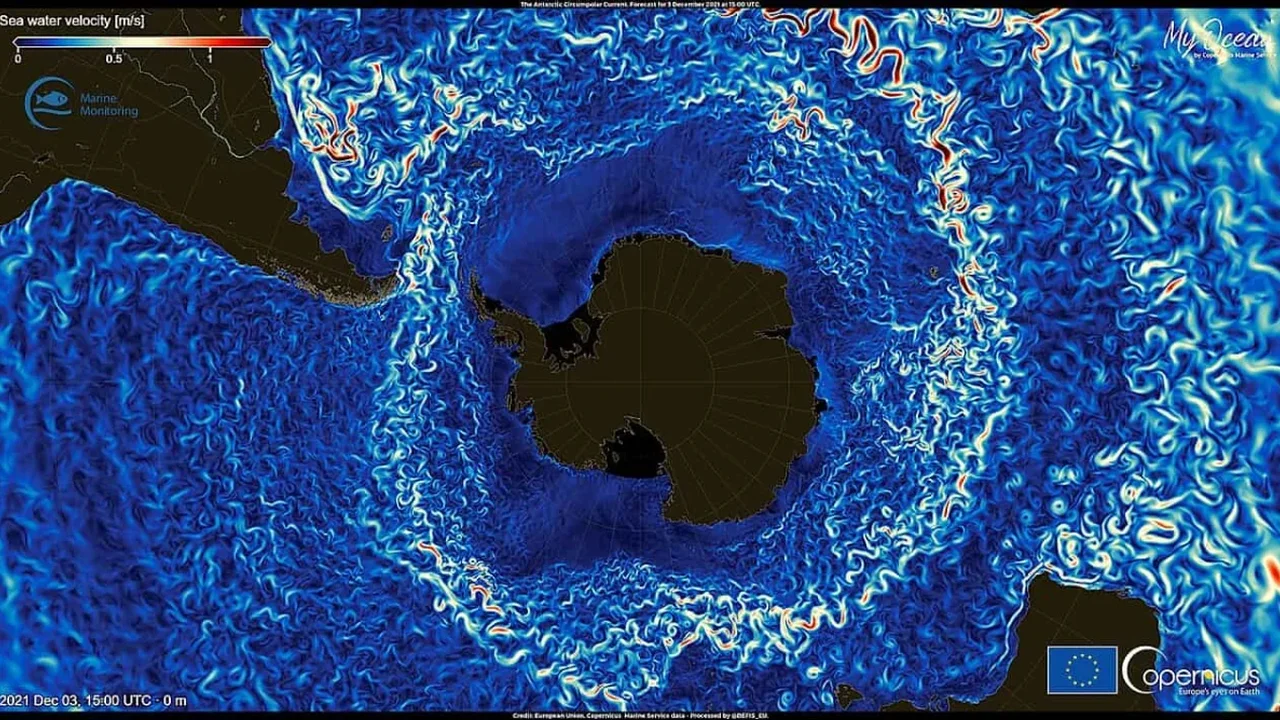
Earth's most powerful ocean current circles Antarctica without touching a single coastline. Known as the Antarctic Circumpolar Current, it moves more than 100 times the combined flow of all rivers on the planet, with estimates reaching 140 to 170 million cubic metres of seawater per second.
A new climate-modeling study suggests that this immense current did not emerge from geography alone. Researchers found that the opening of ocean gateways between Antarctica, South America, and Australia was important, but not sufficient by itself. The missing ingredient was the alignment of strong westerly winds with those passages.
Reconstructing a Deep-Past Ocean
To explore the current's origins, scientists used a high-resolution Earth system model set to conditions from about 33.5 million years ago, during the transition from the Eocene to the Oligocene. They combined ancient geography with a detailed reconstruction of the early Antarctic ice sheet, creating a digital view of a planet in transition.
The simulations showed that early currents were fragmented and unstable. Water could move through the Drake Passage and Tasman Gateway, but the flow did not yet form the continuous loop seen today. Only after Australia drifted farther north and the winds lined up with the gateways did the current fully organize.
According to the researchers, this development likely strengthened Antarctica's thermal isolation and may have supported greater ocean carbon uptake. That process would have helped shape the cooler climate that followed, marking a major step in Earth's long-term climate evolution.
Why It Matters Today
The study also offers a useful perspective for modern climate science. By showing how wind, ice, ocean pathways, and continental movement work together, it helps scientists better understand how large-scale circulation can shift in a warmer, carbon-rich world.
The findings, published in Proceedings of the National Academy of Sciences, highlight a simple but powerful idea: even Earth's largest current depends on precise planetary conditions. That insight may sharpen future climate models and deepen our understanding of how ocean systems evolve over time.
In the years ahead, this kind of research could help improve how we read the ocean's role in shaping climate change and planetary stability.