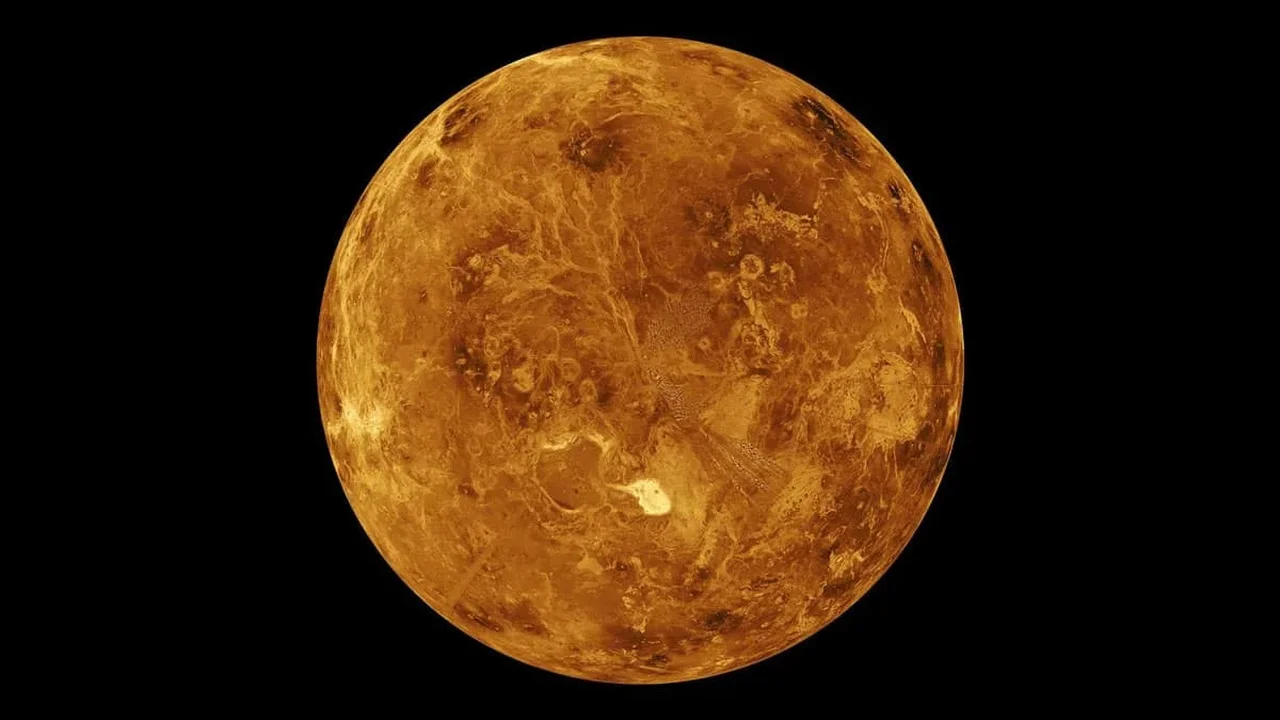
Venus is known for its extreme surface conditions, yet its upper cloud layers continue to attract scientific attention as a possible setting for unusual chemistry. A new study suggests that some peptides can remain stable in concentrated sulfuric acid and form organized structures rather than breaking apart.
Researchers led by planetary scientist Sara Seager examined three laboratory-made peptide chains in highly concentrated sulfuric acid, the dominant component of Venus's clouds. The results, published in the Proceedings of the National Academy of Sciences, showed that the molecules could fold into shapes known as omega loops.
Unexpected molecular stability
Peptides are short chains of amino acids and play important roles in biology on Earth. Until recently, scientists expected concentrated sulfuric acid to rapidly disrupt such compounds. Earlier work from the team had already indicated that some amino acids and nucleic-acid bases could endure this environment, partly because limited water reduces reactions that normally break chemical bonds.
The latest findings add a new dimension: certain peptides not only persist, but may also adopt three-dimensional arrangements. In water, the tested molecules formed relatively flat structures. In sulfuric acid, they instead folded into omega loops with slightly different curvatures.
Not every peptide was stable, and researchers emphasize that the result is not evidence of life on Venus. The experiments examined only a small selection of molecules, while the potential biological role of omega loops remains unclear. Scientists also note that further studies are needed to refine models used to interpret molecular structures in sulfuric-acid-based environments.
A wider view of habitability
The research expands the scientific conversation around what environments may support complex organic chemistry. Rather than assuming that water is the only workable solvent for molecular organization, astrobiologists can now investigate how chemistry behaves in more diverse planetary settings.
Understanding Venus's clouds may ultimately help future missions distinguish between ordinary atmospheric chemistry and more complex molecular signatures. This work could broaden the search for life-friendly chemistry across worlds that once seemed beyond consideration.