Venus and a Possible Lost Satellite
Venus has no moon today, but new modeling suggests it may once have hosted one. According to a study accepted by The Astrophysical Journal, a large early impact could have formed a satellite around the young planet.
Researchers led by Stephen Kane at the University of California, Riverside explored what might happen next in Venus's extreme tidal environment. Their simulations indicate that if Venus spun rapidly after the impact, the moon may first have moved outward, then later reversed course as the planet slowed down.
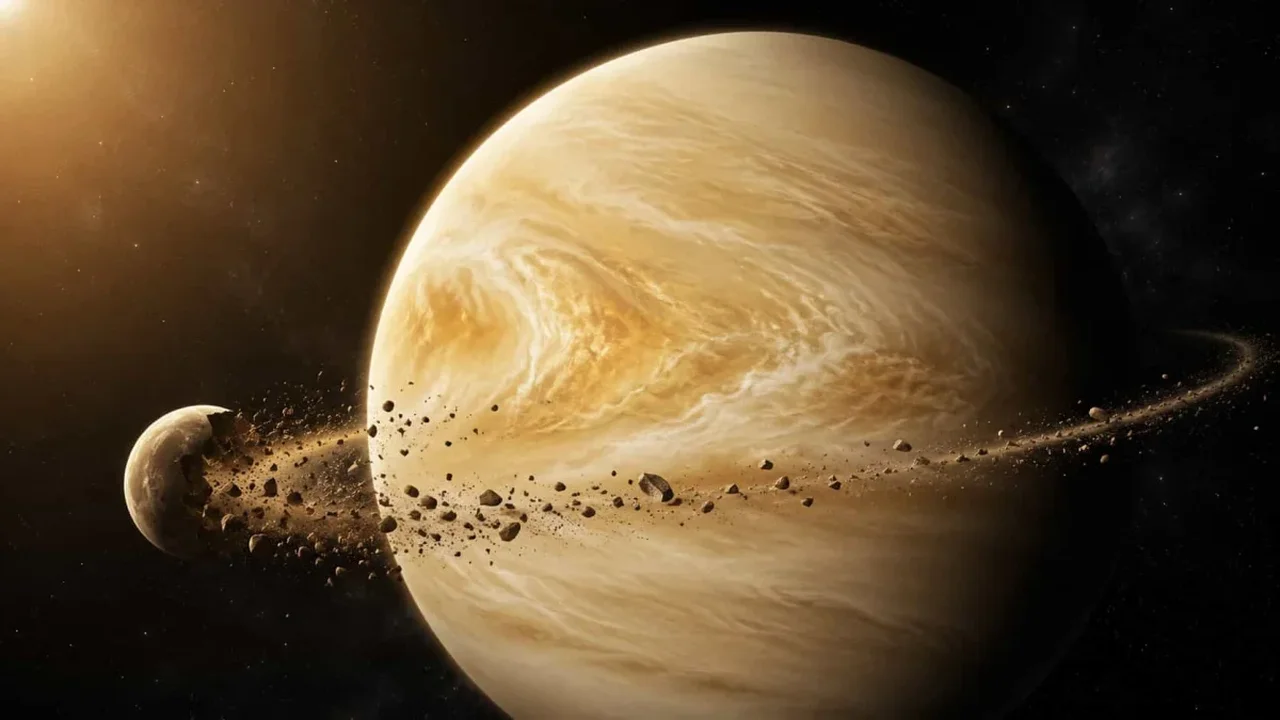
Once that turning point was reached, the moon would have begun spiraling inward. As it approached Venus, tidal forces would intensify until the satellite crossed the Roche limit, where gravity would tear it apart. Some of the debris could have briefly formed a ring before falling onto the planet.
The study does not prove that Venus ever had a moon, but it shows the idea is physically plausible. Early solar system history was shaped by frequent giant impacts, and Earth's own Moon is widely thought to have formed from one such event. Venus, too, may have experienced similar collisions during its formation.
The team also examined how moon size and Venus's interior response to tides would affect the outcome. In some models, a larger moon would have been destroyed faster because it would have slowed Venus more quickly. In others, a smaller or faster-spinning system could have kept a moon in orbit for billions of years.
Beyond orbital dynamics, the study raises a broader question: could a lost moon have influenced Venus's long-term climate? A large satellite might have stabilized the planet's tilt and shaped its tides, while its eventual destruction could have altered the atmosphere and surface evolution.
Future missions such as DAVINCI may help search for chemical clues in Venus's atmosphere that could preserve traces of this ancient chapter. If confirmed, the finding would deepen our understanding of how rocky planets evolve and how moons can shape planetary habitability.