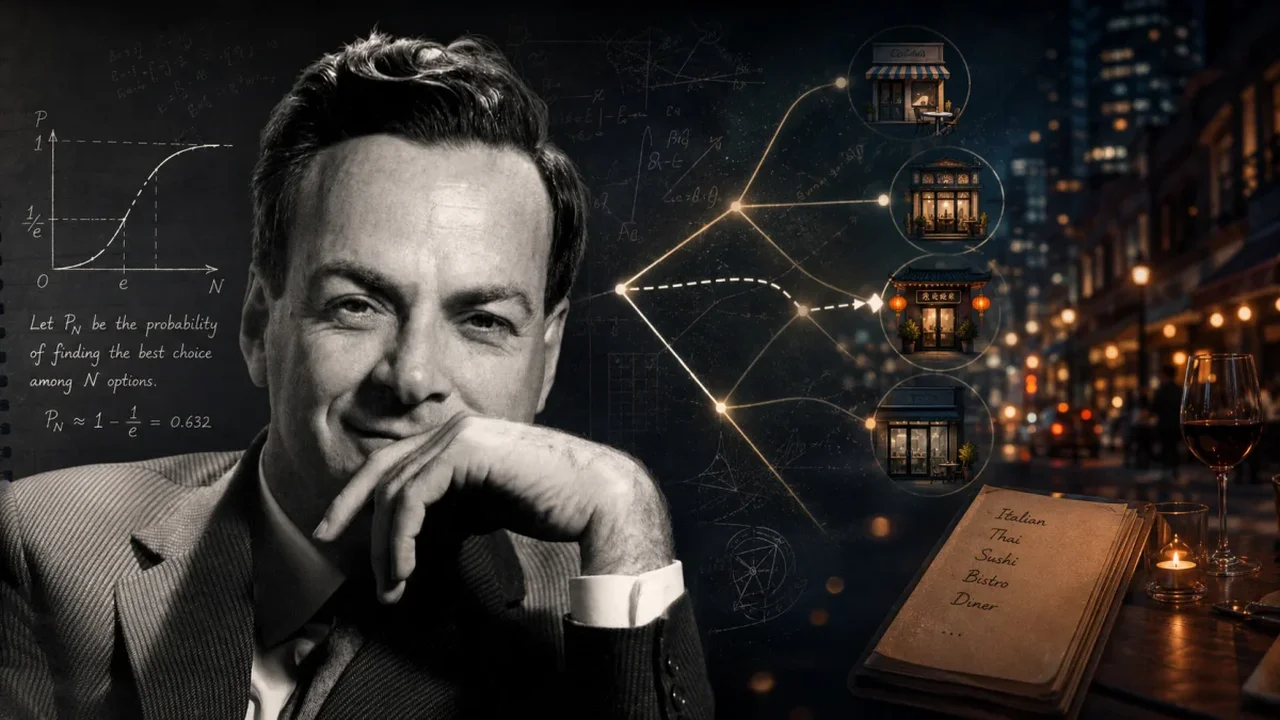
A decades-old set of notes by physicist Richard Feynman has been decoded, turning a familiar dining dilemma into a powerful insight about how people make decisions.
The puzzle began with a simple question: when visiting a city for a limited number of evenings, should someone try a new restaurant or return to the best one already discovered? Feynman's calculations showed that the answer depends on time. Early on, exploration is valuable because a great discovery can be enjoyed repeatedly. As the remaining opportunities shrink, returning to a reliable choice becomes the wiser move.
When Exploration Becomes Commitment
Researchers reconstructed Feynman's handwritten work and confirmed that its central mathematical logic was correct. The challenge belongs to a class of questions known as optimal stopping problems, which examine when people should continue searching and when they should choose an available option.
The model extends well beyond restaurants. Similar choices arise while looking for a home, comparing career opportunities, selecting entertainment or building everyday routines. At the heart of each decision is the balance between discovering something potentially better and benefiting from what is already known.
Feynman's solution uses a flexible threshold. At the beginning of a search, only an exceptional option is worth ending the exploration. Later, that threshold falls, because there is less time to gain from a new discovery. A dependable choice can then become the most valuable one.
People Use Fast, Effective Shortcuts
In experiments involving 2,520 participants, volunteers navigated a virtual restaurant environment over different time periods. They did not follow the exact mathematical strategy, but their choices came remarkably close to its results.
Most participants applied a simpler rule: they began with high expectations and gradually lowered them as their available time declined. This approach achieved around 90 percent of the value predicted by the optimal model.
The finding supports the idea of resource rationality: people often make highly effective decisions without performing exhaustive calculations. Instead, they rely on adaptable mental shortcuts that save time and cognitive effort while remaining well suited to the situation.
Published in the Proceedings of the National Academy of Sciences, the research offers a fresh perspective on human judgment. Rather than seeing "good enough" choices as a failure to optimize, the study suggests they can be efficient responses to limited time and information.
As artificial intelligence and recommendation systems increasingly shape daily choices, Feynman's overlooked puzzle may help inspire tools that better reflect how people explore, learn and confidently decide.