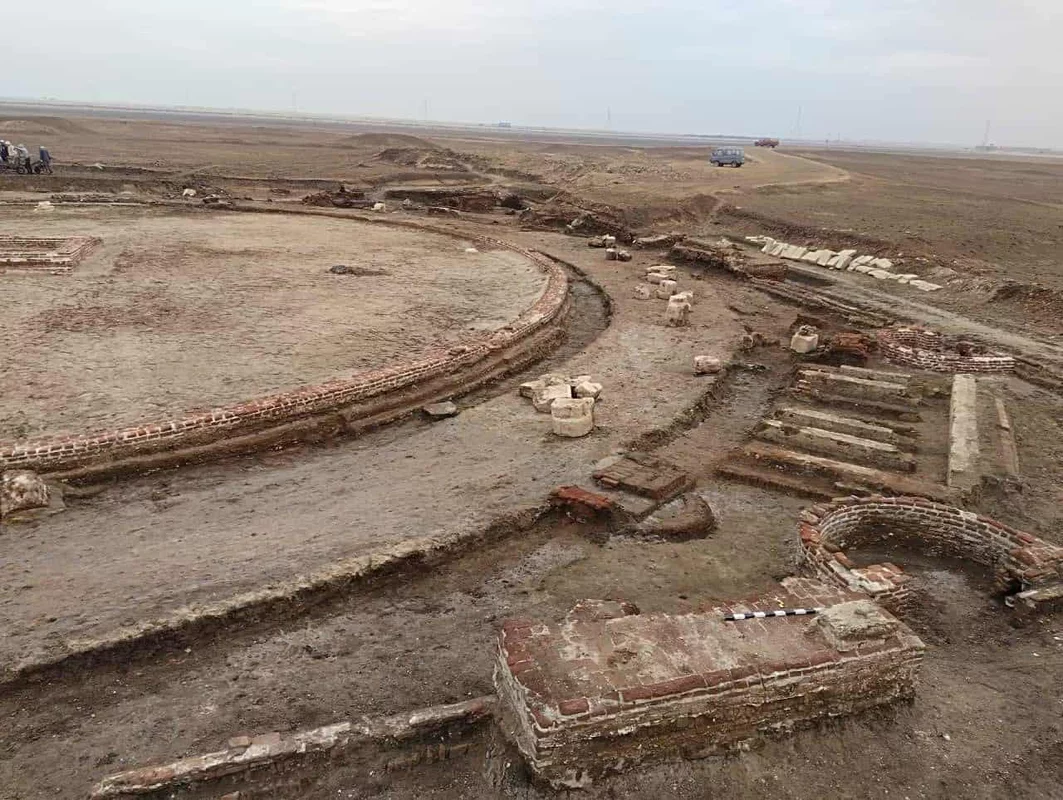
Archaeologists have made a remarkable discovery in the northern Sinai Desert, unearthing a 115-foot circular water temple at Tell el-Farma, previously mistaken for a Roman-era senate house. This site, located at the eastern edge of Egypt's Nile Delta, reveals a sophisticated structure designed to harness the Nile's waters.
Initially, excavations began in 2019, with researchers uncovering only a fraction of the red-brick ruins. However, as the site was further excavated, it became evident that this was not an administrative building but a large basin intended to capture the muddy waters of the Nile River. This structure is believed to be dedicated to Pelusius, a local deity associated with mud, and served as a unique sanctuary.
A Case of Mistaken Identity
The original assumption of a Roman senate house fit well with Pelusium's historical significance as a bustling port city during the Roman Empire. However, as the excavation progressed, the true nature of the site emerged. The circular complex, spanning 35 meters, featured a central basin surrounded by an intricate network of cisterns and drainage systems.
Dr. Hisham Hussein, head of the Central Administration of Antiquities for Lower Egypt and Sinai, emphasized that the hydraulic features of this structure indicated it was a sacred space designed to manipulate water for religious rituals. The discovery has shifted perceptions of Pelusium from merely a military outpost to a vibrant cultural hub.
Harnessing the River's Power
This ancient temple was ingeniously connected to the Pelusiac branch of the Nile, allowing water to flow directly into the basin. Professor Mohamed Abdel Badie, of the Supreme Council of Antiquities, noted that the basin was filled with nutrient-rich Nile silt, crucial for agriculture and human survival in ancient Egypt. The local god Pelusius derives his name from the Greek word "pelos," meaning mud or clay.
Researchers believe the temple hosted elaborate water-based ceremonies, where priests simulated the Nile's annual flooding. This ritualistic interaction allowed worshippers to engage with the concept of renewal and fertility, central to Egyptian life.
At the heart of the basin stood a stone pedestal, likely once supporting a grand statue of Pelusius, symbolizing rebirth and agricultural prosperity. Unlike traditional Egyptian temples, which often feature enclosed pathways, this open-air structure connected worshippers directly with the natural elements they depended on for sustenance.
A Cosmopolitan Crossroads
Pelusium's strategic location facilitated trade and cultural exchange, blending Egyptian traditions with Hellenistic and Roman influences. The temple, constructed in the second century B.C., remained functional for nearly 800 years, demonstrating the resilience of this sacred site.
As Egyptian Tourism and Antiquities Minister Sherif Fathy stated, this discovery not only highlights the archaeological significance of the north Sinai region but also underscores the potential for uncovering further historical treasures that may reshape our understanding of ancient civilizations.