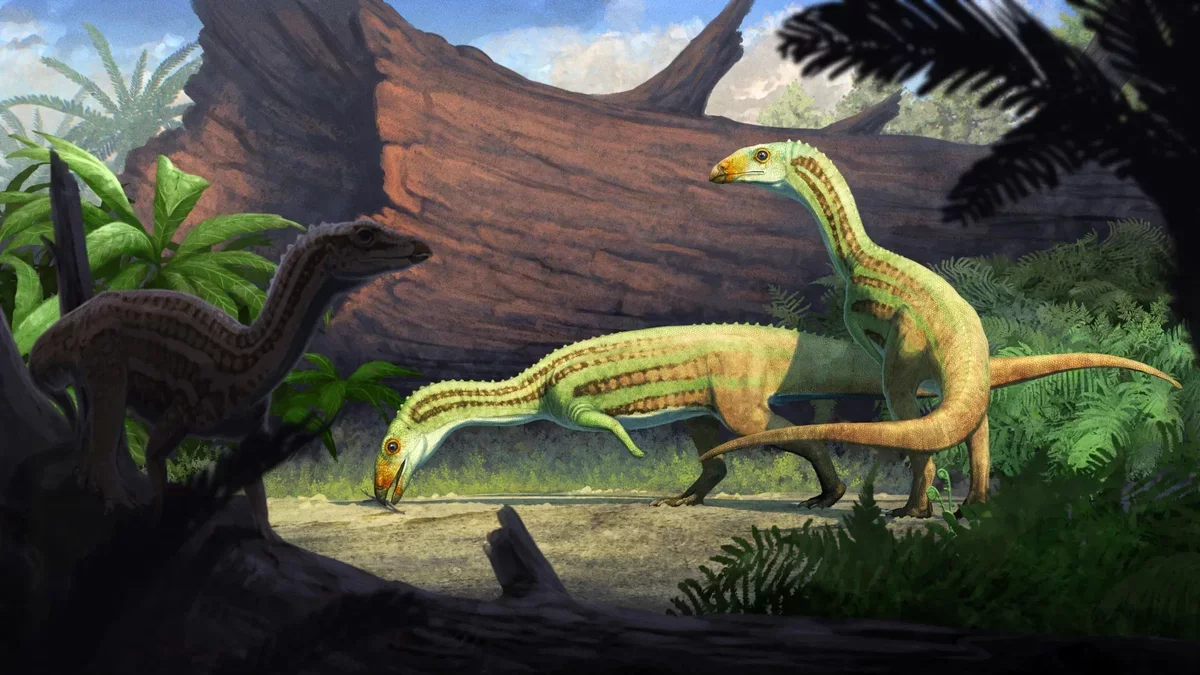
The newly identified species, Sonselasuchus cedrus, belongs to a fascinating group of reptiles known as shuvosaurids. These creatures bore a striking resemblance to ornithomimid dinosaurs that coexisted with them during the Late Triassic period, approximately 225 to 201 million years ago.
Insights from Fossil Analysis
In a recent peer-reviewed study published in the Journal of Vertebrate Paleontology, researchers from the University of Washington's Department of Biology, alongside the Burke Museum, examined fossilized remains that revealed intriguing limb proportions. Their analysis indicates that this small reptile, comparable in size to a poodle, may have transitioned to bipedal movement as it matured.
Lead author Elliott Armour Smith noted, "By studying the limb skeleton proportions of various animals, we concluded that Sonselasuchus likely developed a bipedal stance due to a unique growth pattern." He elaborated that the species initially had more balanced forelimbs and hindlimbs, with the latter becoming longer and sturdier as it aged. "Essentially, these creatures began life on four legs and later adapted to walking on two," he added.
This remarkable adaptation is particularly noteworthy.
Armour Smith, a graduate researcher, collaborated with Professor Christian Sidor from the Burke Museum on this study.
Significant Fossil Discoveries in Arizona
Professor Sidor played a key role in uncovering a treasure trove of 950 Sonselasuchus fossils in 2014 at Petrified Forest National Park in Arizona. Over a decade of excavation at this site has yielded more than 3,000 fossil bones, marking it as one of the richest fossil sites of its kind.
These fossils also shed light on the reptile's physical characteristics. Standing at approximately 25 inches tall, Sonselasuchus likely featured a toothless beak, prominent eye sockets, and hollow bones.
Independent Evolution of Dinosaur-Like Features
Despite its dinosaur-like appearance, scientists stress that the traits seen in Sonselasuchus evolved independently. "While it shares similarities with ornithomimid dinosaurs, these features emerged separately," Armour Smith explained. The convergence of traits likely arose from both croc-line and bird-line archosaurs inhabiting similar ecosystems and fulfilling comparable ecological roles.
Characteristics such as bipedalism, a toothless beak, and hollow bones are indeed reminiscent of ornithomimid theropod dinosaurs, yet shuvosaurids like Sonselasuchus demonstrate that these adaptations also occurred within the croc-line lineage.
Life in the Triassic Ecosystem
This fascinating creature thrived in forested environments, as indicated by its species name, cedrus, which references cedar trees that were prevalent during the Late Triassic.
The genus name Sonselasuchus pays homage to the geological layer where the fossils were discovered, known as the Sonsela Member of the Upper Triassic Chinle Formation, a site renowned for its significant paleontological contributions.
A Decade of Ongoing Research
For Professor Sidor, this research symbolizes over ten years of collaboration with the National Park Service. "Since we began fieldwork at Petrified Forest in 2014, we've collected over 3,000 fossils from the Sonselasuchus bonebed, and the site continues to yield exciting finds," he remarked.
In addition to Sonselasuchus, the bonebed has also produced fossils of various fish, amphibians, and other reptiles, engaging over 30 University of Washington students and volunteers throughout the years. The ongoing discoveries at this site promise to enrich our understanding of ancient life.