Recent research published in Nature Communications reveals that carbon hydride may exist in an extraordinary quasi-one-dimensional superionic state deep within Uranus and Neptune, where extreme pressures and temperatures prevail.
The Importance of Planetary Interiors
With over 6,000 exoplanets identified, the quest to understand planetary formation and evolution has intensified. Collaborative efforts among astronomers, planetary scientists, and Earth scientists are crucial in unraveling the physical processes that shape these celestial bodies, including the generation of magnetic fields.
This collaborative spirit extends to our own Solar System, where studying the hidden layers of planets and moons can yield insights into their behavior and potential habitability.
Unveiling "Hot Ice" Layers
Uranus and Neptune exhibit unique internal structures often referred to as "hot ices," which lie beneath their hydrogen and helium atmospheres and above solid cores. These layers are believed to consist of water (H2O), methane (CH4), and ammonia (NH4), yet the extreme conditions likely transform these common compounds into exotic forms.
Simulating Extreme Conditions
To investigate these phenomena, researchers Liu and Cohen utilized advanced computing and machine-learning techniques to conduct quantum simulations of carbon hydride (CH) under conditions ranging from nearly 5 million to 30 million times Earth's atmospheric pressure and temperatures between 6,740 and 10,340 degrees Fahrenheit.
Discovering a Unique "Spiral" Superionic State
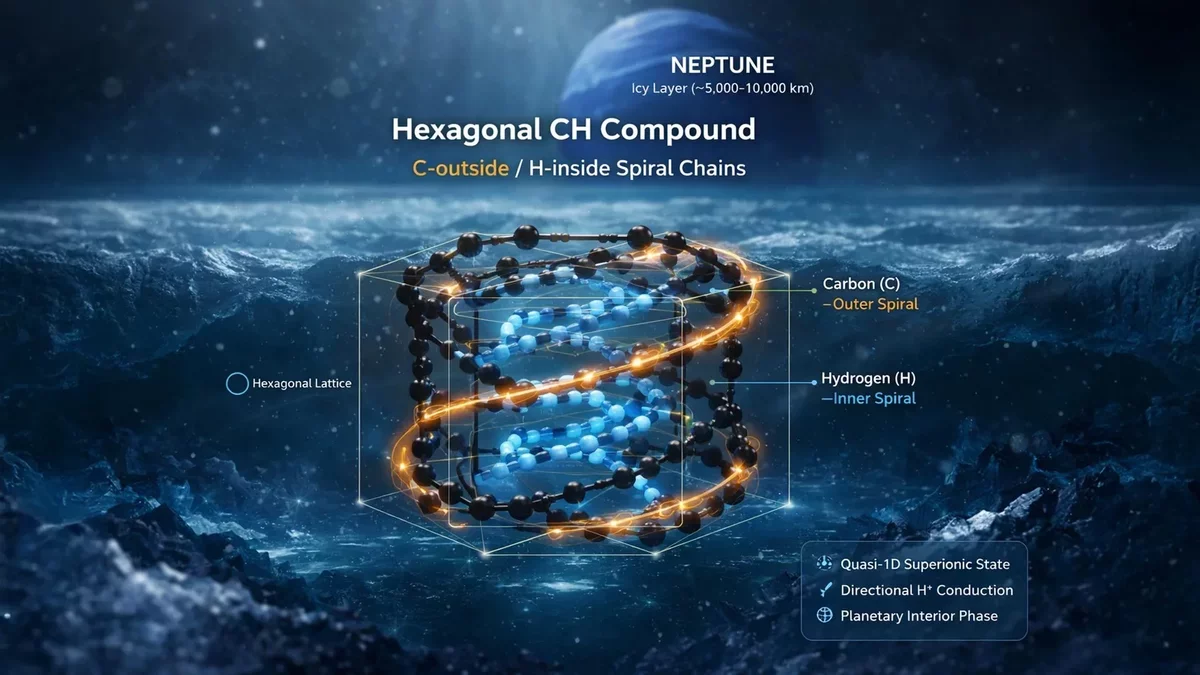
The simulations uncovered a fascinating structure where carbon atoms create a hexagonal framework, allowing hydrogen atoms to spiral through it. This results in a quasi-one-dimensional superionic state, where materials exhibit characteristics of both solids and liquids.
As Cohen noted, "This newly predicted carbon-hydrogen phase is striking because the atomic motion is not fully three-dimensional; instead, hydrogen follows well-defined helical pathways within an ordered carbon structure."
Implications for Energy Dynamics
The directional movement of hydrogen atoms could significantly impact energy transfer within these planets, influencing the transport of heat and electricity through their deep layers. This understanding is vital for deciphering the unique magnetic fields of Uranus and Neptune.
Broader Implications for Science
This research not only sheds light on distant planets but also illustrates how simple elements can exhibit complex behaviors under extreme conditions. Liu emphasized that while carbon and hydrogen are prevalent in planetary materials, their interactions under giant-planet conditions remain largely unexplored.
Ultimately, these findings could pave the way for advancements in materials science and engineering by unveiling new types of directional behavior in matter.