In a remarkable feat of engineering, researchers from St. Olaf College and Syracuse University have developed a functional computer that operates entirely on mechanical principles, utilizing springs and rigid steel bars without any reliance on electricity. This innovative device performs fundamental logic and memory tasks through physical movements and tension, transforming abstract concepts of physics into a tangible computing platform.
The motivation behind creating this mechanical computer lies not in replicating past mechanical calculators, which were prevalent during World War II, but rather in exploring new paradigms of computation. Unlike those historical machines, which were designed for specific calculations, this spring-based model aims to emulate the complex and dynamic behaviors found in materials like crumpled paper and amorphous solids.
Memory in Motion
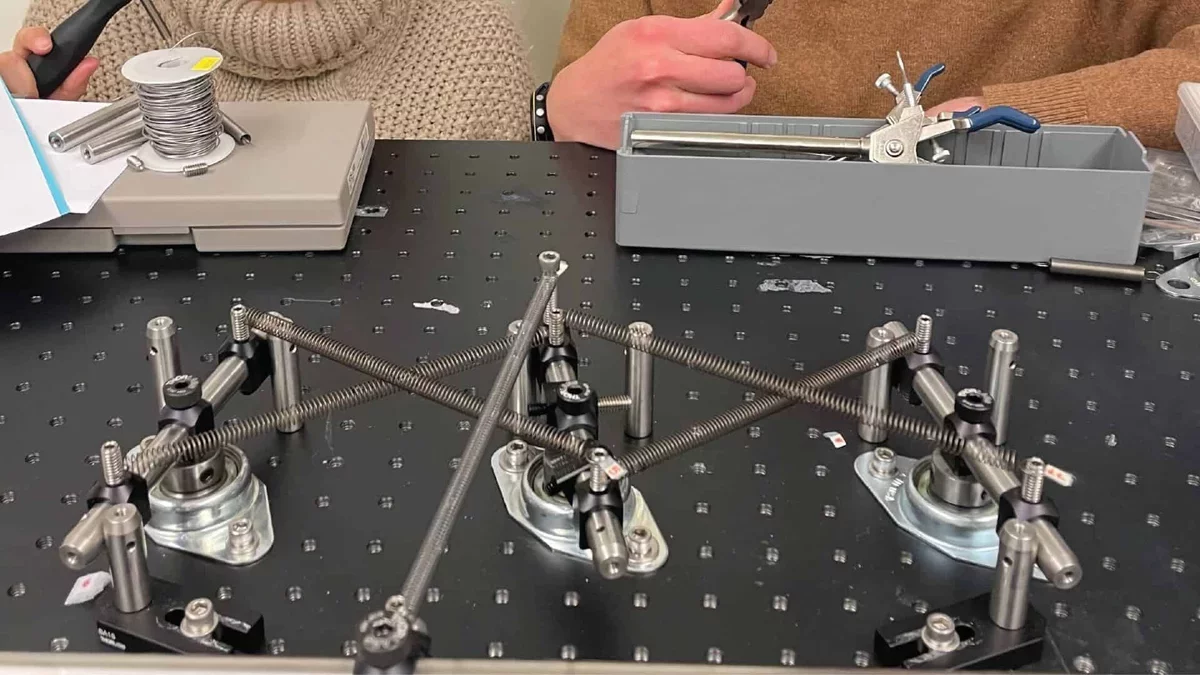
The researchers, led by Professor Joey Paulsen, focused on harnessing the concept of mechanical logic. Their team built simple bistable mechanical units, known as hysterons, which consist of a rigid bar that pivots between two stops, connected to a sliding rod via a spring. This design allows the bar to hold its position until a specific force threshold is reached, at which point it snaps into a new state, demonstrating a form of memory based on its previous states.
The Power of Mechanical Frustration
To enable true computational capabilities, the researchers interconnected multiple hysterons using additional springs. This setup allows for complex interactions, where the bars can either cooperate or take opposing states based on how the springs are configured. This level of dynamic interaction is a significant departure from traditional gear-based computers, offering a new way to approach computation.
Functional Demonstrations
The team successfully built three distinct computing machines to validate their approach. The first acts as a physical counter, tracking the number of times a user interacts with it. The second functions as a logic gate, distinguishing between odd and even inputs. The third demonstrates a latching mechanism, storing information based on the intensity of force applied to it.
Resilience and Future Applications
While these mechanical devices may not replace silicon chips in everyday computing, they offer unique advantages in harsh environments where traditional electronics fail. Their durability makes them suitable for applications in extreme conditions, such as within engines or on space exploration probes.
Moreover, the research opens exciting possibilities for the future of smart materials--structures that can sense their surroundings, make decisions, and respond accordingly. This could lead to advancements in responsive artificial limbs and interactive environments, ultimately enhancing quality of life.
The findings were published in Nature Communications, marking a significant step towards integrating computation into the very fabric of materials.