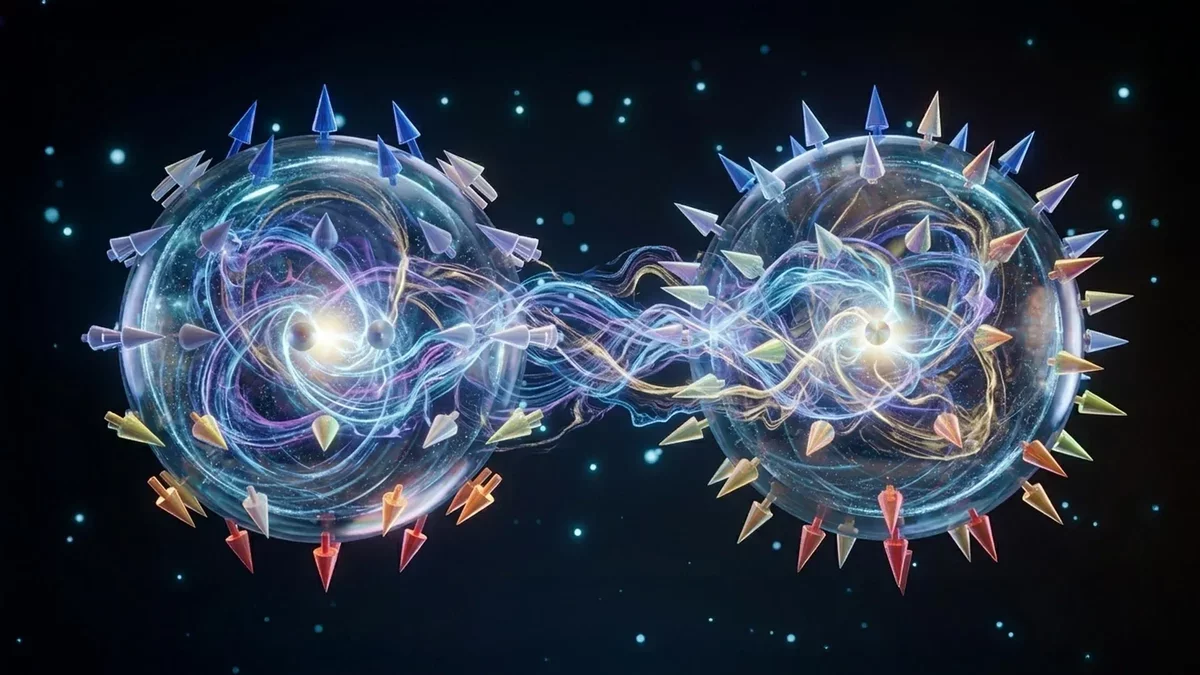
In quantum optics laboratories, a common method for generating entangled photons is known as spontaneous parametric downconversion (SPDC). Recent research has unveiled a fascinating hidden dimension within the spatial structure of light, revealing a complex realm of high-dimensional topologies. These intricate patterns hold the potential to enhance data storage and improve the resilience of quantum systems against noise.
The research team showcased this phenomenon through the orbital angular momentum (OAM) of light, which can range from basic two-dimensional forms to extraordinarily high dimensions. This adaptability enables the formation of significantly more elaborate structures than previously acknowledged.
Topology Derived from a Single Property
Published in Nature Communications, the study illustrates that by measuring the OAM of two entangled photons, researchers can uncover an intrinsic topology that is a fundamental characteristic of the entanglement. Since OAM can adopt an infinite array of values, the corresponding topologies can also expand into very high dimensions.
Professor Andrew Forbes from the Wits School of Physics noted, "We report a major advance: we only need one property of light (OAM) to create a topology, whereas it was previously thought that two properties--typically OAM and polarization--were necessary. The implication is that as OAM is high-dimensional, so too is the topology, allowing us to observe the highest topologies ever recorded."
Furthermore, the researchers discovered that once the topology exceeds two dimensions, it cannot be defined by a single numerical value. Instead, a spectrum of topological values is needed, indicating a much richer and more intricate structure than traditional optical systems.
A Discovery Hiding in Plain Sight
One remarkable aspect of this finding is its accessibility. The necessary resources are already available in most quantum optics labs, eliminating the need for specialized equipment or a "quantum engineer" to harness this effect.
Pedro Ornelas remarked, "You obtain the topology effortlessly from the spatial entanglement. It was always present; it just required discovery."
Theoretical Insights Confirmed by Experiment
Lead author Prof. Robert de Mello Koch from Huzhou University explained that identifying these structures was challenging. "In high dimensions, pinpointing where to search for topology is not straightforward. We applied abstract concepts from quantum field theory to predict where to look, and our experiments confirmed our hypotheses!"
Advancing Robust Quantum Technologies
While orbital angular momentum entanglement has been extensively studied, it has often been perceived as delicate. The researchers propose that examining it through the lens of topology could alter this view. By utilizing these newly identified structures, scientists could pave the way for more reliable quantum systems, potentially leading to practical applications in the real world.