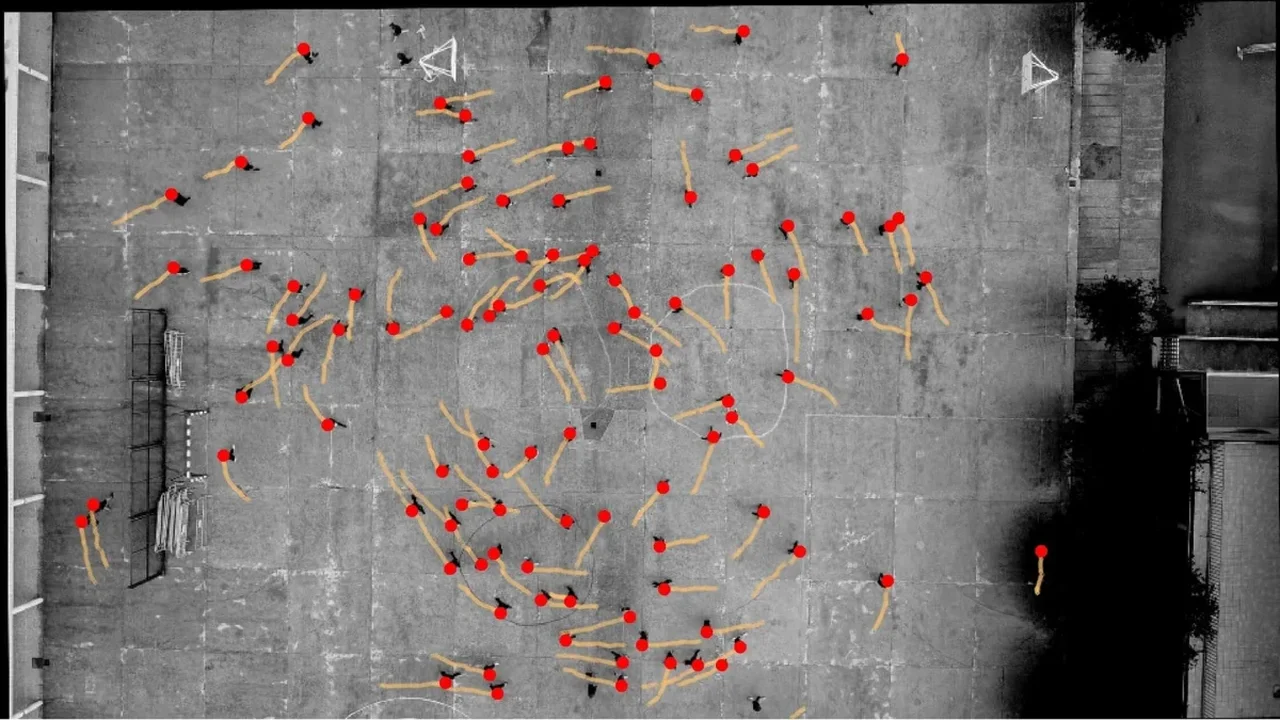
People asked to walk freely in open spaces may be following a subtle shared pattern: a tendency to turn counterclockwise. New experiments in Spain and Japan found that this directional preference appeared in both groups and individuals.
A Pattern That Begins With Individual Movement
Researchers observed the effect across a wide range of settings, from circular indoor areas to a large schoolyard. In an early series of trials, 32 of 33 groups showed a counterclockwise tendency while moving freely.
The pattern remained visible when participants walked alone, suggesting it is not created solely by crowd interactions. Computer simulations using individual walking data were also able to reproduce the same collective rotational movement.
Scientists examined several possible explanations, including handedness, dominant foot, eye dominance, gender, walls and group size. None produced a consistent link to the turning preference. The effect also appeared in Japan, indicating that local pedestrian habits alone are unlikely to explain it.
Children Show an Even Stronger Tendency
Observations involving young children found a particularly pronounced counterclockwise flow. Because children have had less exposure to formal walking conventions and public-space routines, the result may point to a deeper feature of human movement rather than a learned social rule.
The mechanism is still unresolved. Researchers are exploring whether small asymmetries in balance, stride control, attention or the body's motion-sensing systems could influence how people naturally navigate space.
Designing Spaces Around Human Flow
The findings, published in Nature Communications, may offer useful perspectives for the design of airports, museums, stations, stadiums and shopping environments. Understanding natural circulation preferences could help planners create routes that feel more intuitive and support smoother pedestrian movement.
This small behavioral bias could eventually inspire public spaces that work more closely with human movement, turning everyday walking patterns into smarter, more responsive design.