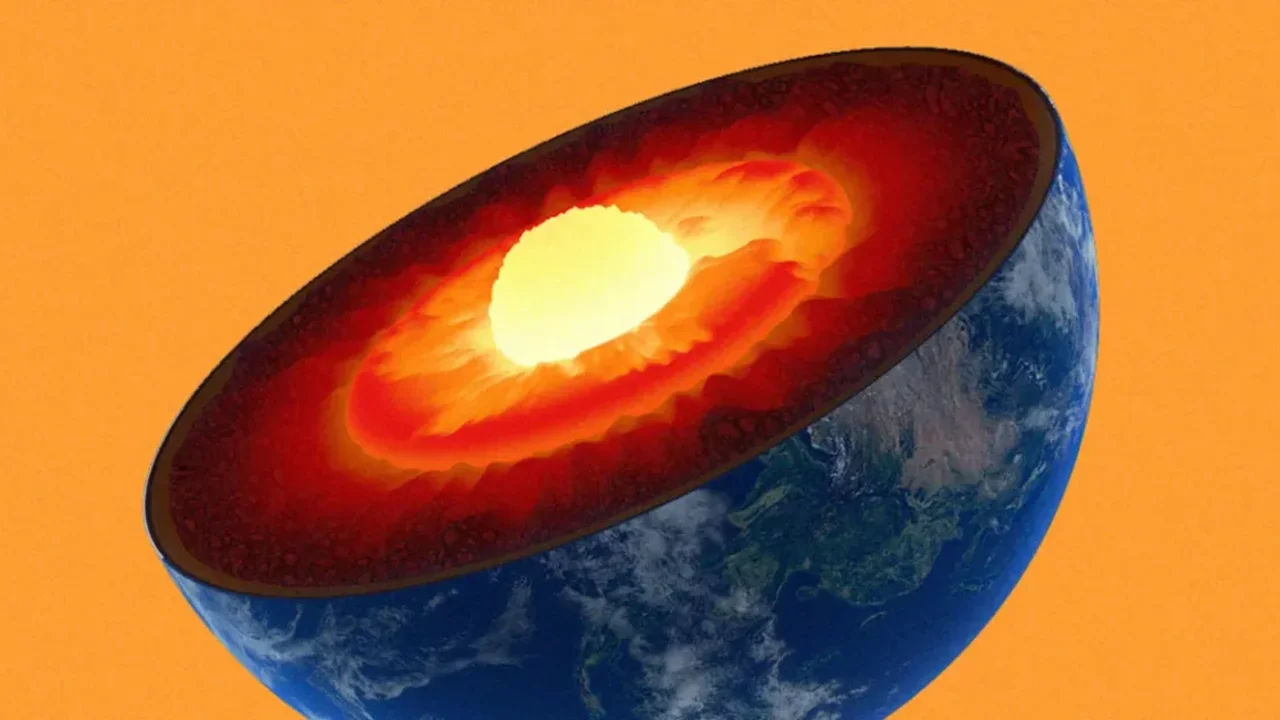
New research suggests Earth's core may store far more hydrogen than previously imagined -- potentially the equivalent of 9 to 45 oceans if converted into water. The finding adds a fresh layer to our understanding of how the planet formed and how its deep interior still shapes life at the surface.
What the experiments revealed
Scientists led by Motohiko Murakami at ETH Zurich recreated extreme core-like conditions in the lab using a laser-heated diamond anvil cell. By compressing and heating iron with water-bearing material, they observed hydrogen, oxygen, and silicon moving into molten metal and becoming chemically integrated into the alloy.
Rather than existing as free water or gas, the hydrogen appears to be locked inside iron-rich structures deep within the core. That mechanism offers a plausible route for hydrogen to have been transported inward during Earth's early differentiation, when the planet separated into layers.
Why it matters for Earth and beyond
Based on the measured hydrogen-to-silicon ratio, the team estimates hydrogen may account for about 0.07% to 0.36% of the core's mass. While that sounds small, the core is so massive that the total becomes significant on a planetary scale.
The result also supports the idea that much of Earth's water-related material may have been present during the planet's main formation stage, rather than arriving only later. Beyond Earth, the study may help researchers model the interiors of rocky exoplanets and better understand how light elements influence planetary evolution.
Published in Nature Communications, the study opens a new window into the deep Earth and the hidden chemistry that may have helped shape our world. In the future, this kind of research could refine how scientists trace water, magnetic activity, and planet formation across the solar system.