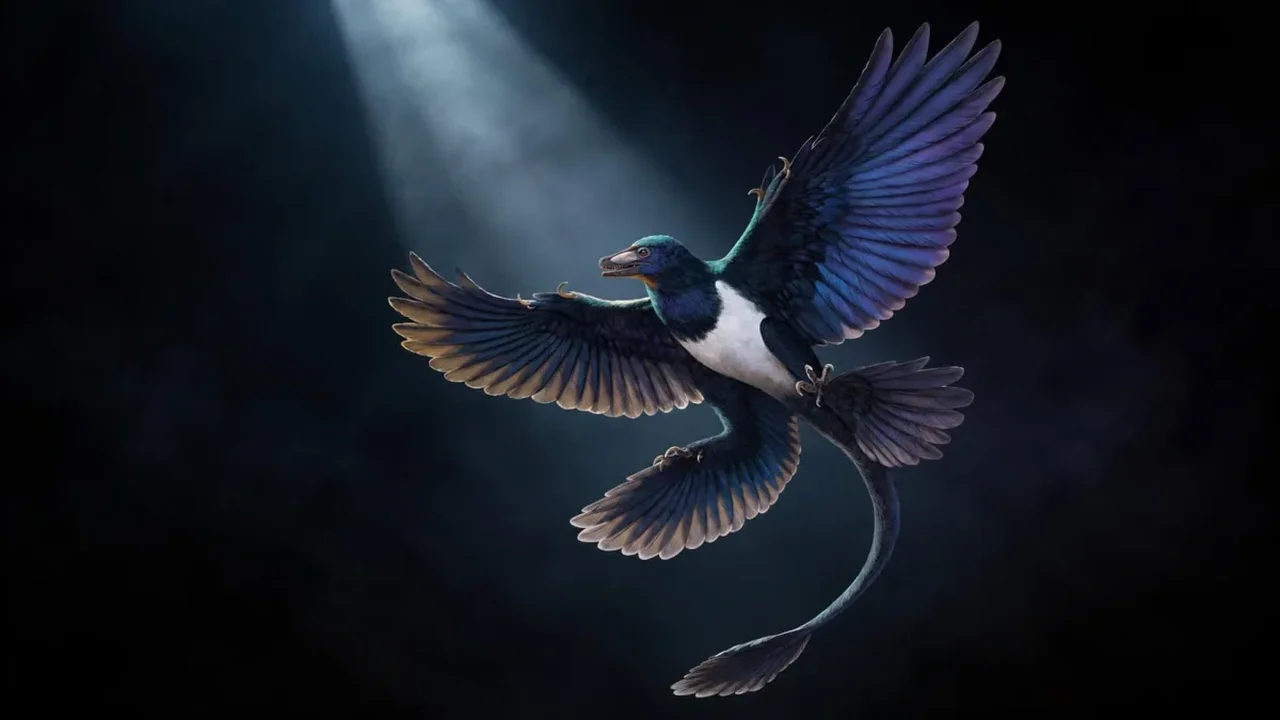
A newly identified feathered dinosaur from northeastern China is offering a fresh perspective on one of evolution's most remarkable achievements: flight. The species, Norellraptor barsboldi, belonged to the microraptorines, a group of small predatory dinosaurs closely related to early birds.
Unearthed from the Early Cretaceous Jiufotang Formation in Liaoning, the nearly complete 57-centimeter specimen preserves feather traces around its forelimbs, hindlimbs and tail. This distinctive arrangement gave the animal a four-winged appearance, with feathered legs potentially contributing to balance, steering and aerial movement.
Similar wings, separate evolutionary routes
Researchers examined the dinosaur's skeleton and compared it with other microraptorines, early birds and related dinosaurs. Their evolutionary analysis identified 194 anatomical changes within the microraptorine lineage. Around 30% of the traits associated with this group also emerged independently in birds.
These shared characteristics included stronger forelimbs, changes to the breastbone and ribs, an elongated ulna, and small thumb feathers known as alular feathers. In modern birds, these feathers play an important role in controlling airflow during flight.
However, the order in which these adaptations appeared was not the same. Microraptorines seem to have developed shorter finger bones before acquiring several other flight-related traits. In early birds, features such as an elongated breastbone and fused wrist-and-hand bones emerged earlier.
This difference suggests that the two groups may have reached comparable aerodynamic solutions through distinct evolutionary sequences rather than inheriting one fully formed flight blueprint from a common ancestor.
A new view of dinosaur innovation
The findings, published in Nature Communications, support the possibility that key wing and flight adaptations arose independently among different dinosaur branches. While the fossil does not settle whether microraptorines used sustained powered flight, gliding, or a blend of both, its anatomy points to an advanced experiment in aerial mobility.
Its well-developed breastbone may have supported substantial muscles, while the hind wings could have enhanced stability and maneuverability. Norellraptor barsboldi therefore expands the picture of dinosaurs not as a single route toward birds, but as diverse innovators testing multiple ways to move through the air.
As new fossils and biomechanical studies emerge, this discovery could reshape how science understands the repeated evolutionary experiments that eventually made the skies accessible to vertebrates.