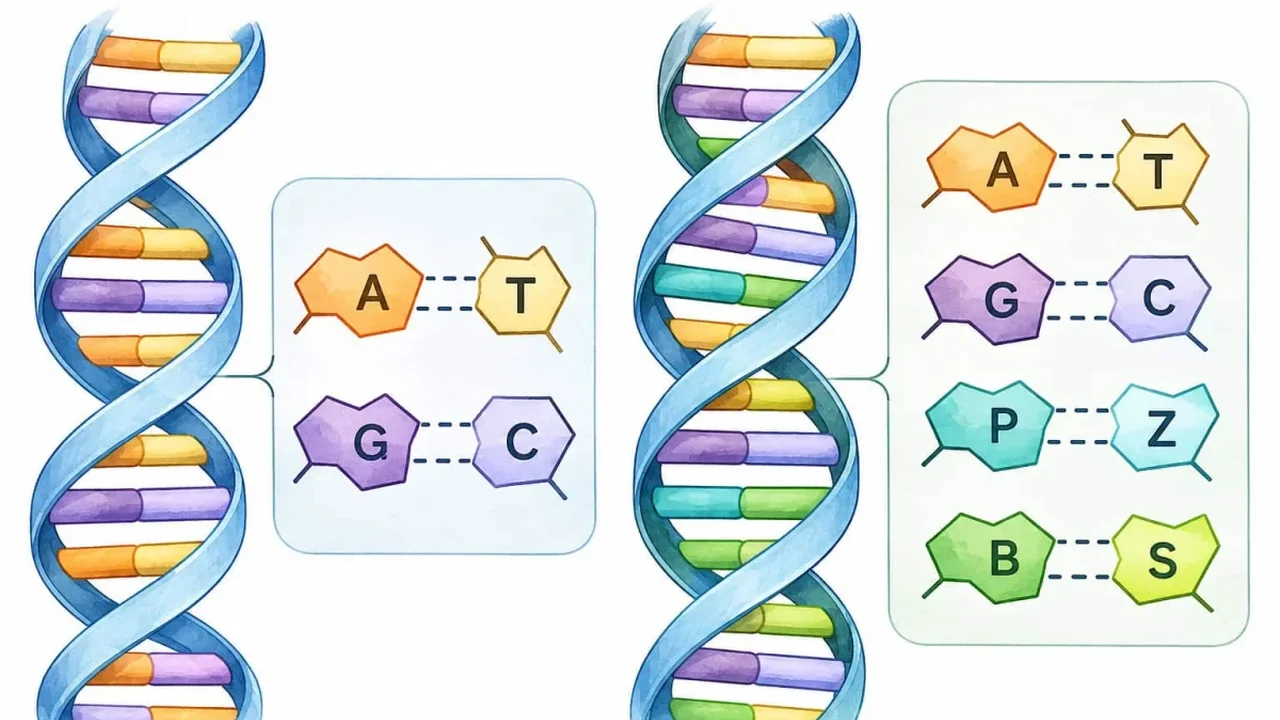
All known life uses four DNA bases--A, T, G and C. But a laboratory study from the University of California San Diego shows that a key cellular enzyme can also read a synthetic, expanded alphabet.
Researchers tested E. coli RNA polymerase, which normally copies DNA instructions into RNA. Using purified enzyme and engineered genetic strands, they found it could transcribe DNA containing eight letters: the natural bases plus two artificial pairs, P-Z and B-S. The enzyme generally recognized the intended partners and continued copying across the synthetic bases.
Improving the synthetic alphabet
One challenge was that Z sometimes paired incorrectly with the natural base guanine. The team designed a modified version, Z*, that reduced this unwanted pairing while still matching with P.
The result does not mean researchers have created an eight-letter bacterium. The experiments took place outside living cells, and the next steps include testing whether cells can maintain an expanded genome and whether its instructions can be used to make proteins. The study was published in Nature Communications.
By showing that a natural molecular machine can process a broader genetic code, the research points toward new possibilities for designing nucleic acids and proteins with useful properties beyond those found in nature.