Crafting the perfect espresso is an intricate art that goes beyond mere brewing techniques. A slight adjustment in grind size can transform coffee beans into a harmonious shot, a sour dribble, or an overly bitter brew.
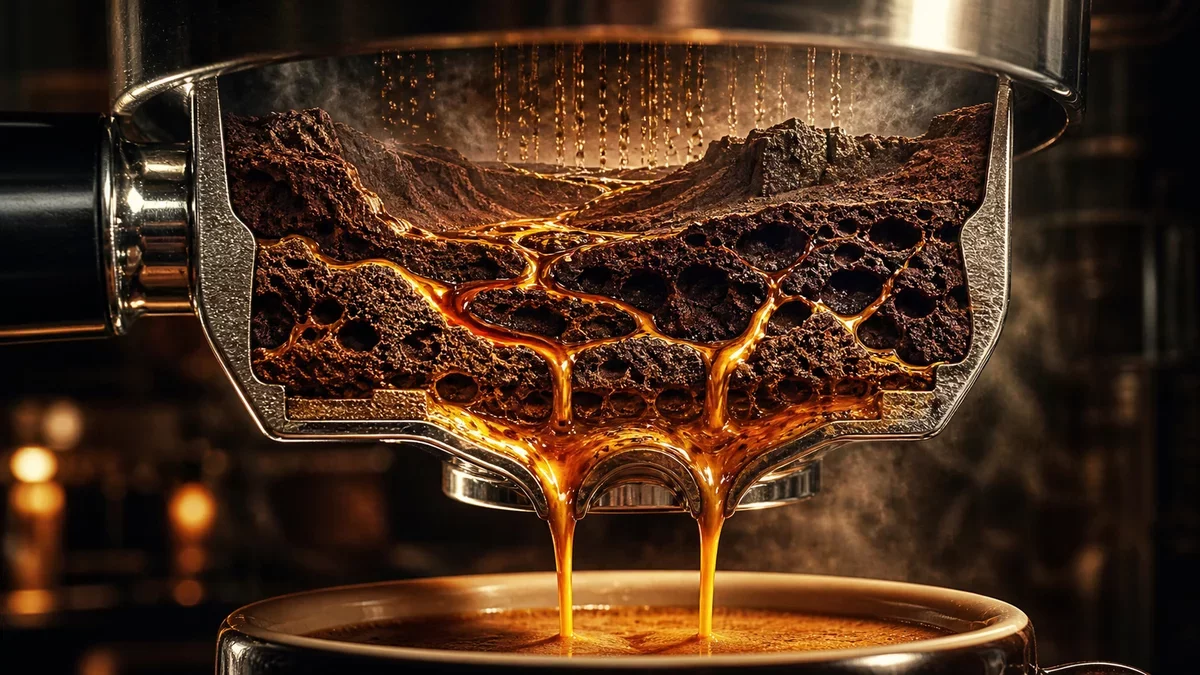
While past research primarily focused on the chemistry of coffee, a groundbreaking study proposes that the path to espresso excellence may lie in geological principles. Inside the portafilter, the compacted coffee grounds resemble a miniature landscape filled with ridges, channels, and dead ends. As hot water is forced through these grounds at high pressure, its flow patterns determine the quality of the espresso. A rapid rush can lead to a thin, sour taste, while a sluggish passage can extract too much and result in bitterness.
The research suggests that the same mathematical models used to analyze fluid movement through porous geological materials can be applied to coffee grounds. This insight emphasizes the importance of grind size, a variable often overlooked by home brewers.
The Hidden Dynamics of the Coffee Puck
Espresso begins with ground coffee beans compressed into a puck, which, while appearing solid, is a complex network of pathways. Fabian Wadsworth, an earth scientist at Ludwig-Maximilians-Universität München, has utilized coffee as a practical tool to teach concepts of percolation, drawing parallels between volcanic eruptions and coffee brewing.
As gas escapes from magma and water flows through sediment, the movement of hot water through coffee grounds hinges on the size and shape of the pores within the puck.
The study's authors developed a mathematical model focusing on the interconnected pore spaces and surface area of coffee grounds, concluding that these factors significantly influence coffee permeability. High permeability allows water to flow swiftly, while low permeability obstructs it, affecting taste.
Mapping Coffee with Advanced Technology
To validate their model, researchers analyzed two types of coffee, Tumba from Rwanda and Guayacán from Colombia, grinding them at various settings to produce different samples. Using X-ray computed micro-tomography, they created 3D maps of the ground coffee, revealing the intricate structures that influence fluid movement.
The findings indicated that the irregular shapes of coffee particles greatly impact the surface area available for water interaction. Doubling the grain size, for instance, can quadruple permeability--affecting how quickly water can extract flavors.
Finding the Right Grind Size
While many novice baristas instinctively grind their coffee finer to enhance flavor extraction, this can lead to over-extraction and undesirable bitterness if the puck becomes too compact. Conversely, overly coarse grounds may result in a weak brew. The ideal grain size for a balanced espresso is suggested to be between 145 and 275 micrometers, comparable to the thickness of a human hair.
Ultimately, the quality of the beans remains significant, but this research highlights that even modest beans can yield exceptional results when ground correctly.
Bridging the Gap Between Disciplines
This study illustrates how principles from volcanology can enrich our understanding of coffee brewing. By treating espresso preparation as a scientific endeavor, we can unlock new dimensions of flavor and experience.
As modern espresso machines evolve to incorporate pressure and flow measurements, the future may hold the potential for devices that automatically adjust brewing parameters, taking the guesswork out of crafting the perfect cup.