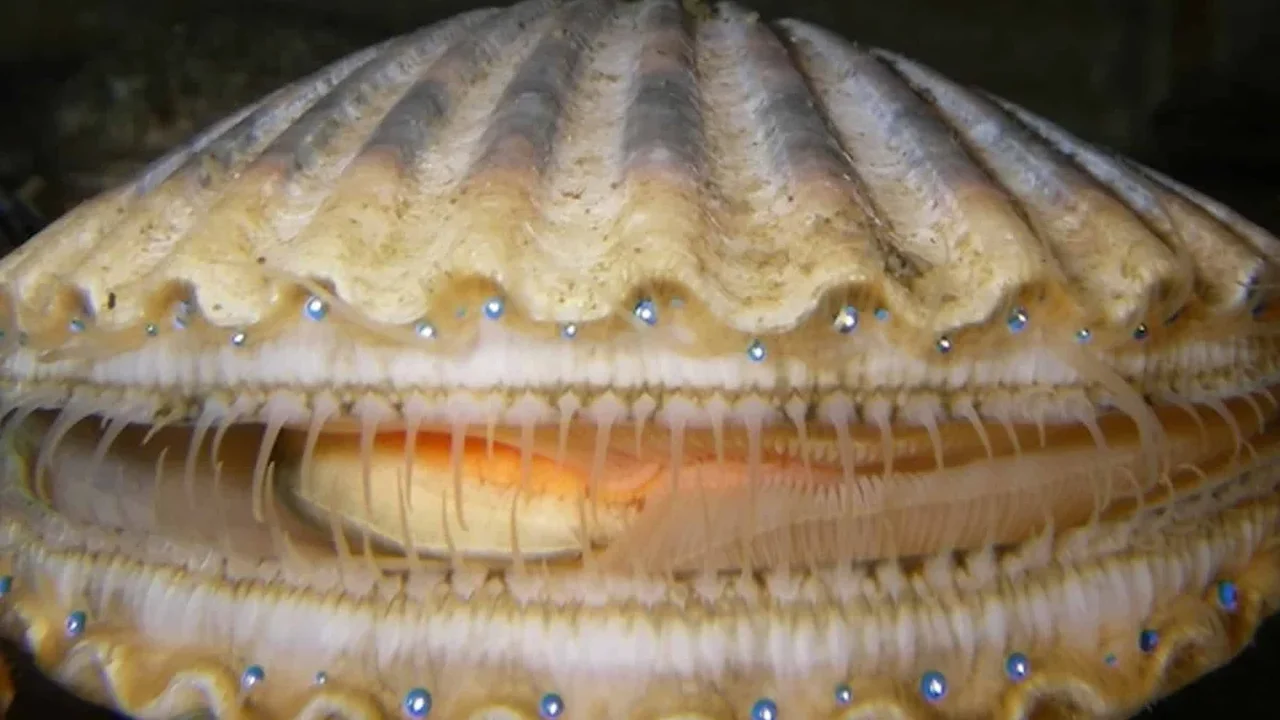
Scallops may appear simple, but along the edges of their shells they can have as many as 200 tiny eyes. Rather than relying mainly on lenses to focus light, these marine mollusks use curved mirrors inside their eyes--a design reminiscent of reflecting telescopes.
A mirror built from crystals
A 2017 study by researchers at the Weizmann Institute of Science, published in the journal Science, detailed how the mirrors are made. Each contains millions of microscopic, square-shaped guanine crystals arranged in layers. Guanine, also found in DNA, reflects light effectively; stacked crystal layers create a reflective surface that helps focus light inside the eye.
The mirror's shape directs light toward two separate layers of light-sensitive cells. Research suggests the upper retina responds to dark, moving objects, potentially helping scallops detect approaching animals. Their mirrors also reflect blue-green wavelengths particularly well, matching the light that travels furthest through seawater.
Eyes that adapt to changing light
Scallops can adjust their pupils, although the process takes several minutes. In bright conditions, the pupils narrow; in dimmer settings, they widen to admit more light. This involves a trade-off: a wider pupil increases light sensitivity, while a narrower one can produce a sharper image.
Scientists are still investigating how scallops combine information from their two retinal layers and how their many eyes shape their overall perception. Studying the crystal arrangement may also inspire new approaches to reflective materials and miniature optical systems. Nature's design could offer fresh ideas for future optics as researchers learn more about how it works.