Physicists have measured quasiparticles with an effective electrical charge of almost exactly one-quarter of an electron's charge, offering a precise new look at one of quantum physics' most intriguing collective states.
The result comes from independent experiments at the Weizmann Institute of Science and EPFL. Both teams explored the fractional quantum Hall state known as ν = 1/2, where electrons confined to an ultrathin semiconductor layer behave collectively under extreme cold and a powerful magnetic field.
Collective quantum behavior
Electrons themselves remain fundamental particles with a fixed charge. Yet, in specially engineered materials, many interacting electrons can form collective disturbances called quasiparticles. These excitations move through the system like particles and can display fractional electric charges.
The experiments used a 70-nanometre gallium arsenide layer cooled close to absolute zero and exposed to a magnetic field of around 12 tesla. Under these conditions, the electron system entered a highly ordered quantum regime.
Measuring charge through electrical fluctuations
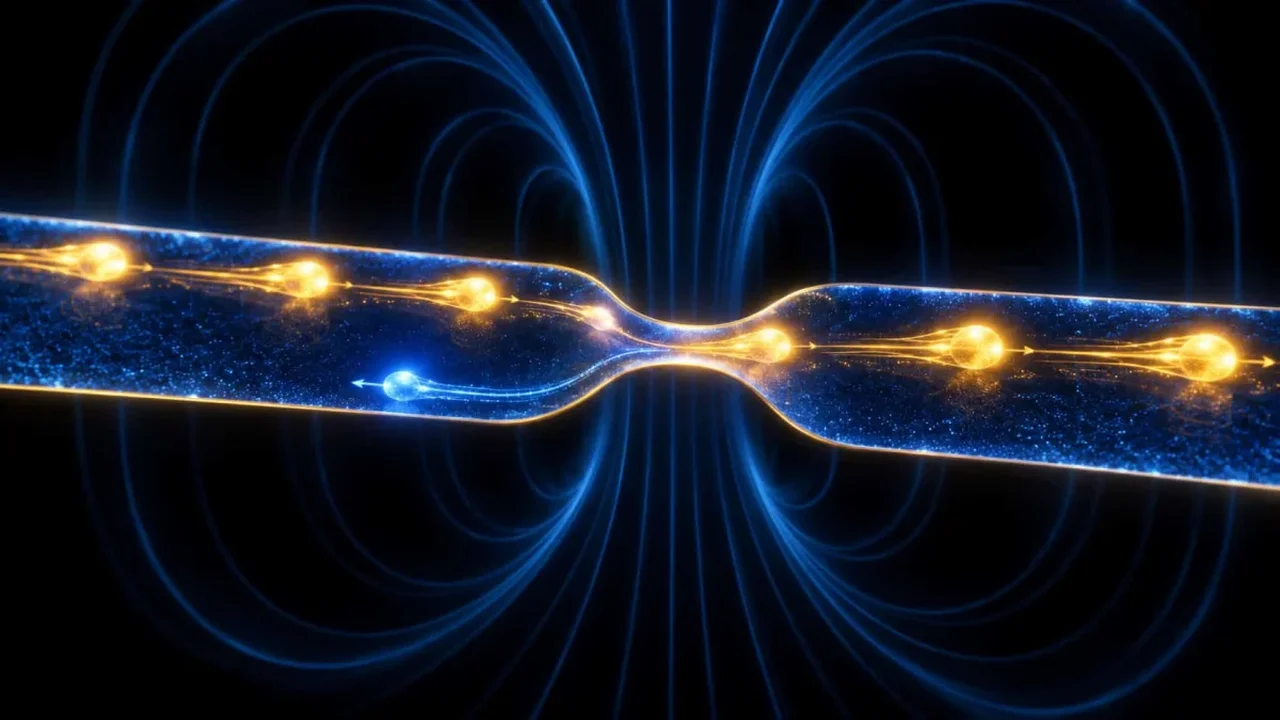
Rather than observing quasiparticles directly, researchers examined tiny fluctuations in electrical current passing through a narrow quantum point contact. This method, known as shot-noise measurement, reveals the charge carried by individual quantum excitations.
One measurement found an effective charge of 0.25 electron charge, within a narrow margin of uncertainty. A second experiment reached an almost identical value of 0.249. Together, the findings provide strong confirmation that the ν = 1/2 state supports excitations with e/4 charge.
The work, reported in Physical Review Letters, does not yet determine the exact quantum identity of these quasiparticles. Some theoretical models suggest they could be non-Abelian anyons, unusual states whose interaction patterns may preserve quantum information more reliably than conventional systems.
This measurement strengthens the experimental foundation for studying topological quantum states and could guide future designs for more resilient quantum computing technologies.