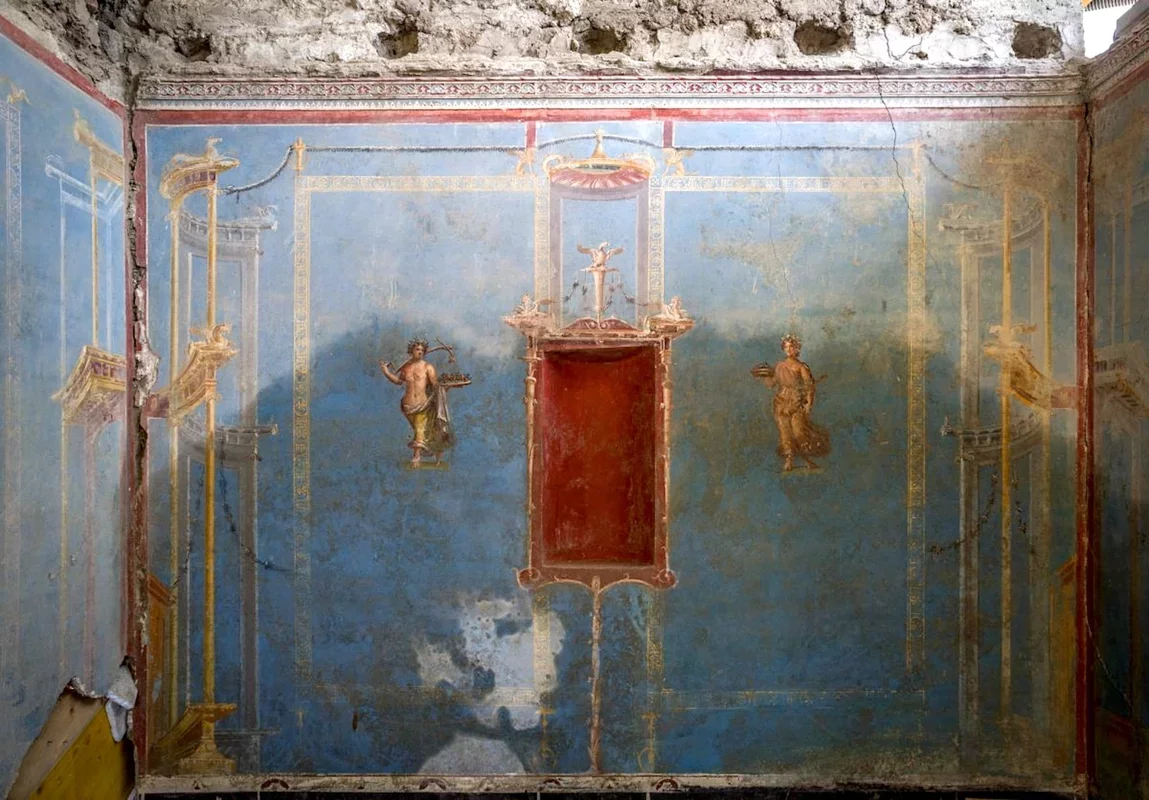
In the summer of 2024, a captivating "Blue Room" was uncovered in the ongoing excavations of Pompeii, specifically within Regio IX of this ancient Italian city. The room's walls, adorned with the remarkable Egyptian blue pigment, suggest that it served a significant purpose beyond a typical living space, likely functioning as a sacrarium for household rituals and sacred objects. A recent study published in the journal Heritage Science delves into the lavish nature of these pigments, estimating the cost of painting the entire room in the first century CE.
Reproducing the color blue has historically posed challenges due to its rarity in nature. The pigment, originally derived from Lapis lazuli, was sourced from the distant mountains of Badakhshan, now in northeastern Afghanistan, making it a highly valued commodity. This led to the innovation of Egyptian blue, created from a mixture of heated sand, lime, copper, quartz, and alkali flux. This synthetic pigment first appeared in Ancient Egypt around 3300-3200 BCE and gained popularity across Anatolia and Mesopotamia. By the first century BCE, the Roman architect Vitruvius documented its existence, referring to it as caeruleum, with production occurring in Puteoli, near Pompeii.
Recent analysis of the Blue Room, led by Mishael Quraishi--a Massachusetts Institute of Technology graduate specializing in material science and archaeology--employs advanced techniques like visible light-induced luminescence and electron microscopy. The findings revealed that artisans would have required between 2.7 and 4.9 kg (5.95 to 10.80 lbs) of pigment to cover the room's walls.
The owners of this luxurious residence, complete with a thermal bath and a spacious dining area, likely invested significantly in the room's decoration. Researchers referenced the work of ancient historian and pigment expert Hilary Becker from Binghamton University to ascertain the costs associated with Egyptian blue. Becker evaluated the grades of the pigment as noted by Pliny the Elder, who perished during the eruption of Vesuvius in 79 CE. According to Pliny, general caeruleum was priced at 8 denarii per libra, while a superior variant, caeruleum vestorianum, cost 11 denarii per libra.
Utilizing these literary references alongside mathematical models for room dimensions, the research estimates the total cost of pigment at between 93 and 168 denarii. For perspective, this amount could purchase between 744 and 1344 loaves of bread. Notably, a Roman foot soldier's annual salary was approximately 187 denarii, indicating that the pigment cost represented a substantial portion of their yearly income.
In addition to pigment expenses, the study sheds light on the labor costs associated with painting in antiquity. Previous research by Francesca Bologna estimated that grinding pigments required between 31 and 56 labor hours for the Blue Room alone.
The exploration of Pompeii's Blue Room not only highlights the opulence of wealthy citizens but also signifies a leap forward in employing scientific methods to reconstruct the vibrant lives of ancient Romans. The use of color in their environments conveyed profound meanings, and a room entirely painted in blue symbolized a striking display of Roman wealth.