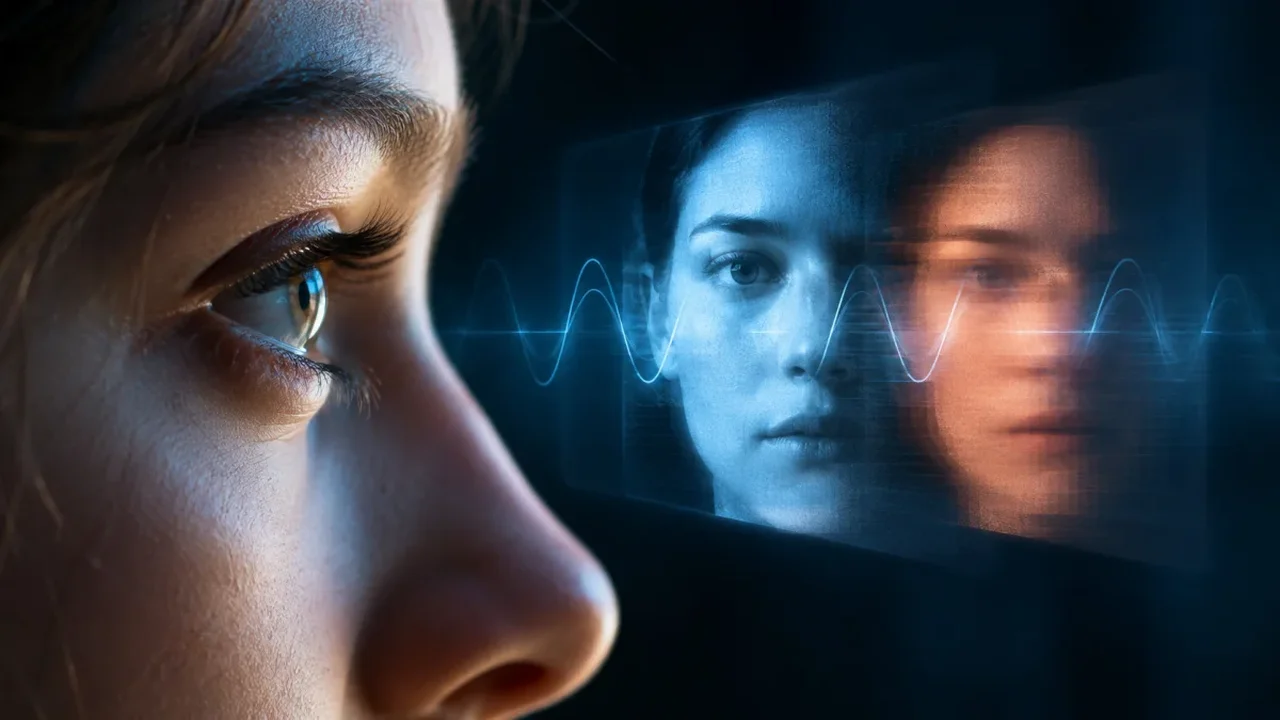
The brain may process more of what we see than ever reaches conscious awareness. A study led by researchers at the University of California, Berkeley and Princeton University found that, during a visual illusion, neurons rapidly alternate between representing an image we perceive and one that remains outside awareness.
The team presented two different faces to two rhesus macaques using a technique called binocular flash suppression. A face shown to one eye was quickly replaced in awareness by a second face flashed to the other eye, even though both images continued to reach the eyes. In an initial test, 14 people viewing the same setup reported seeing the newly flashed face most of the time.
Neural activity in brief time windows
Using probes to record activity from hundreds of neurons, researchers tracked signals in brain areas involved in visual recognition and higher-level thought. They found that the same neurons alternated between the perceived and suppressed faces at roughly 15 cycles per second, or in periods around 60 milliseconds long.
When researchers analyzed the activity in these short intervals, they could reconstruct both faces from neural signals. The image associated with conscious perception was represented with about 21% greater sensitivity to facial features. Averaging activity over longer periods, by contrast, blended the two representations together.
The findings suggest that conscious perception may depend not only on which brain regions are active, but also on the timing of neural activity. The research, posted as a preprint on bioRxiv, examined specific brain areas in only two monkeys and has not yet undergone peer review. The mechanism that coordinates these rapid shifts remains unknown.
Further research could clarify how the brain filters experience and may reshape scientific models of attention and consciousness.