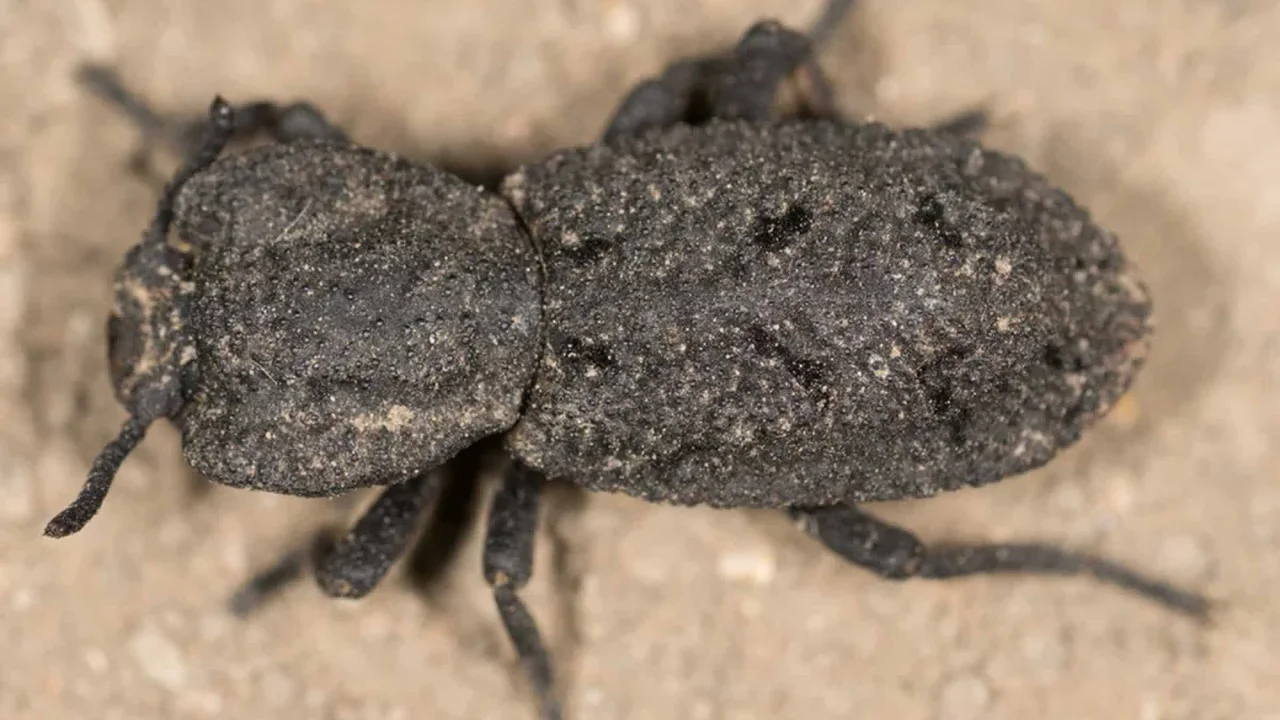
The diabolical ironclad beetle, a flightless insect about two centimeters long, can withstand pressure that would crush many creatures of similar size. Its secret is not simply a hard shell: its protective structure is designed to distribute force and resist sudden failure.
The beetle's hardened wing covers meet along a seam made of interlocking, jigsaw-like structures. When pressure rises, these connections hold the shell together. At extreme loads, some layers can gradually separate, absorbing energy instead of allowing the entire structure to snap apart.
In research published in Nature in 2020, teams from the University of California, Irvine, and Purdue University examined the beetle's armor using imaging, mechanical tests and computer models. In compression tests, its exoskeleton endured about 150 newtons--roughly 39,000 times the insect's body weight--before beginning to fracture.
From insect armor to aircraft materials
Engineers are adapting the beetle's design principles to address a longstanding challenge: joining materials without creating vulnerable points. Conventional fasteners can add weight and concentrate stress, while repairs to aircraft composites may leave a weak boundary between a patch and the original material.
A beetle-inspired carbon-fiber fastener demonstrated the potential of interlocking connections, while later research applied similar ideas to tougher ceramic assemblies. In a 2026 study, researchers tested a puzzle-like repair interface for composite materials. It withstood 30.47 percent more peak force in tensile tests and 8.65 percent more in bending tests than a conventional circular-step repair.
These findings are still at the research stage; further testing is needed before such designs can be used in real aircraft. But the beetle offers engineers a compelling model for structures that manage damage rather than failing all at once. That approach could help shape lighter, more resilient materials for future vehicles and infrastructure.