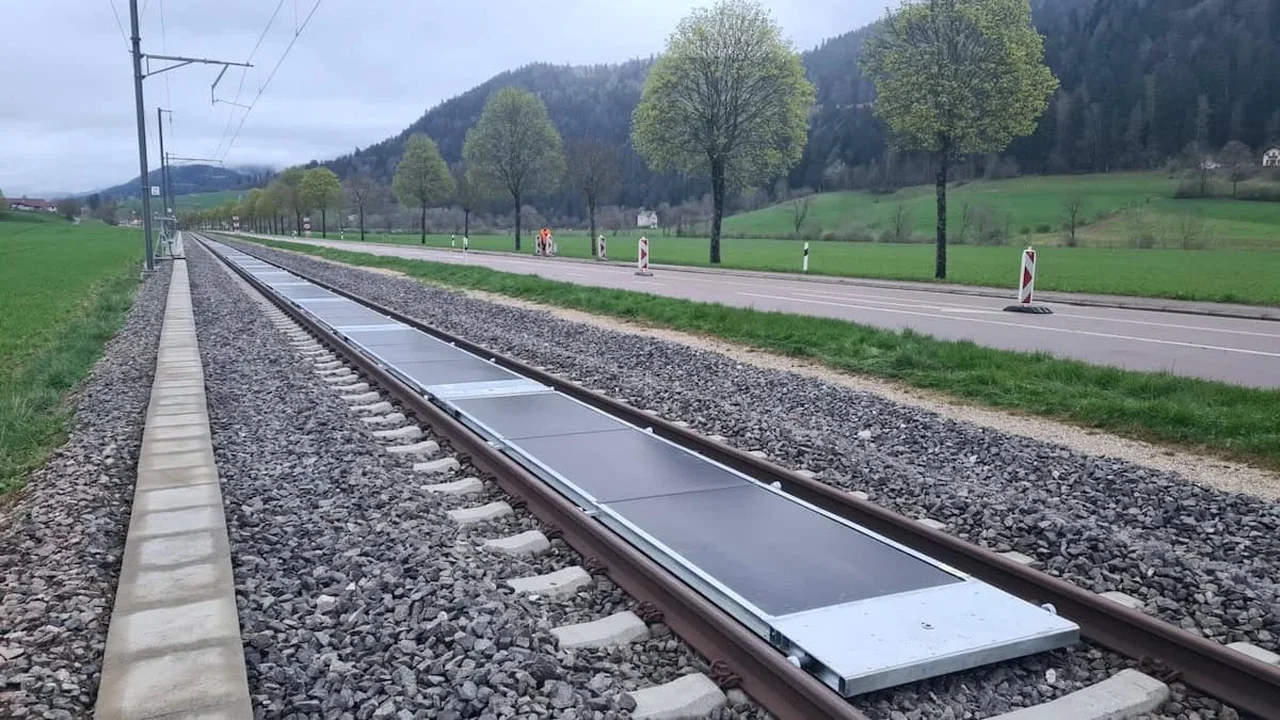
Switzerland has launched an unusual clean-energy pilot that places solar panels directly between active railway tracks, allowing trains to pass over them while the system captures sunlight below.
In the canton of Neuchâtel, near the village of Buttes, 48 removable panels have been installed across a 100-meter stretch of Line 221. The project, led by Swiss startup Sun-Ways, is designed to generate around 18 kilowatts of power and produce roughly 16,000 kilowatt-hours annually.
A new model for using existing infrastructure
The concept is built around a simple idea: use space that already exists instead of expanding onto farmland, forests, or scenic terrain. Sun-Ways says the panels can be laid by a specialized railway machine developed with track maintenance company Scheuchzer, then removed whenever maintenance is needed.
That flexibility is central to the project. Rail corridors are busy infrastructure zones, so any solar system must avoid interfering with inspections, repairs, signaling, or train operations. The current pilot is meant to test exactly that balance over a three-year period through April 2028.
During the trial, researchers and railway partners will examine installation speed, glare, dirt buildup, compatibility with rail equipment, and long-term maintenance needs. The project is also being monitored by French rail stakeholders, including SNCF and SNCF Réseau, which are reviewing the technical results for possible future use.
Why the idea matters
Solar panels on rail lines face tougher conditions than rooftop systems: vibration, dust, snow, ballast movement, and repeated pressure from passing trains. To address those challenges, Sun-Ways says it has developed tougher modules, anti-glare coatings, sensors, and cleaning brushes that can move with trains.
If the pilot proves reliable, the model could open a new path for solar expansion in places where land use is limited or highly protected. Sun-Ways estimates that Switzerland's rail network alone could support meaningful clean power output if scaled carefully.
For now, the Buttes project is a practical test of whether railways can become part of the energy landscape. If successful, it could help redefine how modern transport corridors contribute to the clean-power future.