Recent research has unveiled a significant transformation in the behavior of phosphorus chains, influenced by their spacing. When these chains are distanced apart, they exhibit properties akin to semiconductors. Conversely, closely packed chains are predicted to function as metals.
Transitioning from Two Dimensions to One
Materials are composed of atoms that bond in diverse configurations. In typical solids, atoms interconnect both horizontally and vertically. Certain elements, like carbon, can create graphene, a two-dimensional (2D) hexagonal lattice where atoms bond solely within a single layer. Phosphorus also has the ability to establish stable 2D forms.
The fascination with two-dimensional materials stems from their unique electronic and optical characteristics. Theoretical models propose that further miniaturizing these materials into one-dimensional forms could yield even more extraordinary electro-optical phenomena.
Self-Organizing Phosphorus Chains on Silver
Under meticulously controlled conditions, phosphorus atoms can align into short, linear formations on a silver substrate, appearing one-dimensional in structure. However, these neighboring chains may still influence each other laterally, which can modify the electronic framework and potentially hinder true one-dimensional behavior. Until now, researchers struggled to definitively ascertain whether the electrons were confined to a singular dimension.
"Our comprehensive analysis of measurements at BESSY II has confirmed that these phosphorus chains indeed exhibit a one-dimensional electronic structure," states Professor Oliver Rader, who leads the Spin and Topology in Quantum Materials department at HZB.
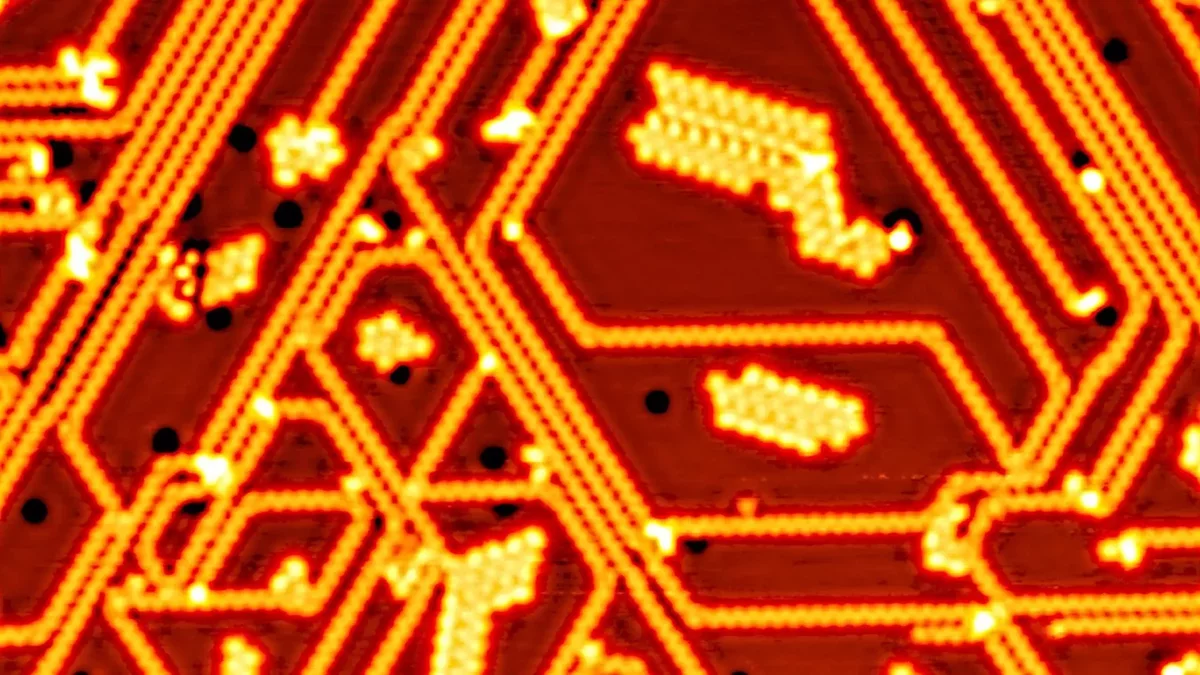
Dr. Andrei Varykhalov and his team first synthesized and studied the phosphorus chains using a cryogenic scanning tunneling microscope (STM), revealing short chains oriented in three distinct directions across the silver surface, separated by 120-degree angles.
ARPES Confirms Authentic 1D Electronic Structure
"We achieved exceptional results, observing standing electron waves forming between the chains," Varykhalov explains. The team subsequently mapped the electronic structure using angle-resolved photoelectron spectroscopy (ARPES) at BESSY II, a technique in which they possess significant expertise.
Forecasted Semiconductor-to-Metal Phase Transition
Dr. Maxim Krivenkov and Dr. Maryam Sajedi played pivotal roles in analyzing the data. By meticulously separating the contributions from the three differently aligned chain domains, they could isolate each chain's electronic signature. "We successfully disentangled the ARPES signals from these domains, demonstrating that these 1D phosphorus chains indeed possess a unique 1D electron structure," Krivenkov remarks.
Calculations based on density functional theory corroborate the experimental findings and indicate a crucial shift as the chains draw closer. Enhanced interactions between adjacent chains are anticipated to instigate a phase transition from semiconductor to metal as the density of the chains increases. In essence, a tightly packed two-dimensional arrangement would lead the material to behave like a metal.
"We have ventured into a novel research domain, an unexplored area where numerous thrilling discoveries await," Varykhalov concludes.