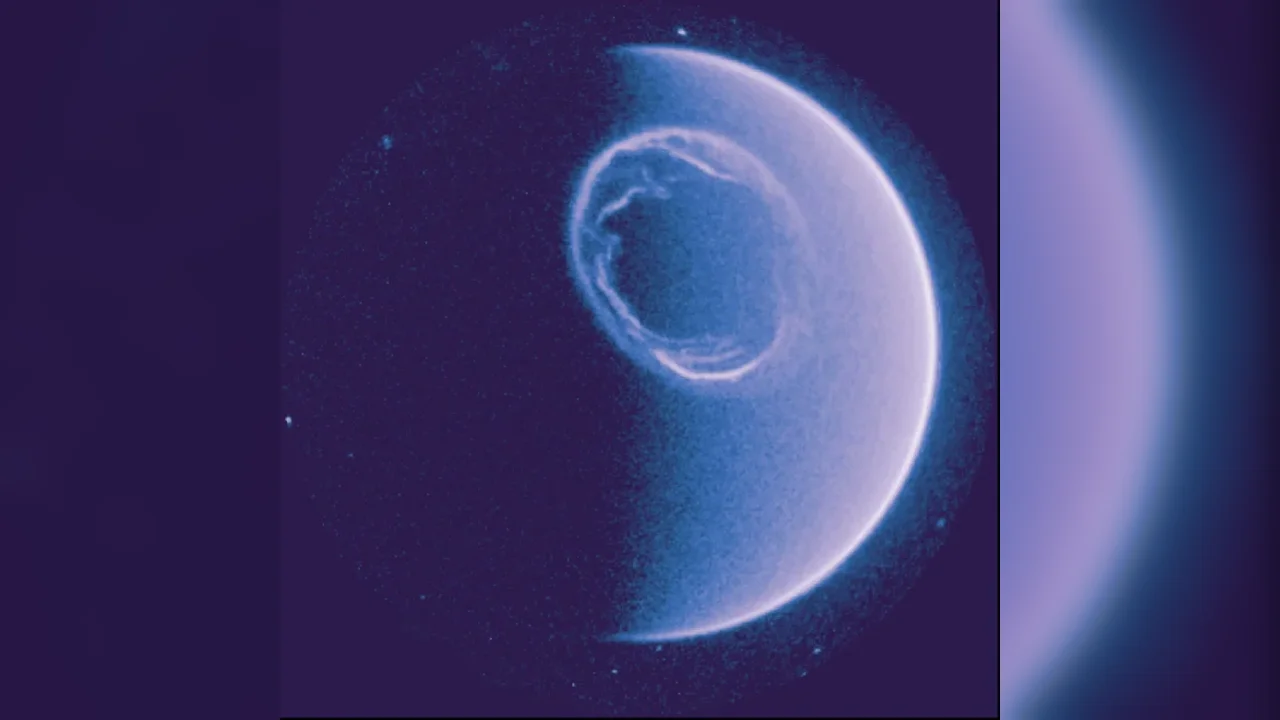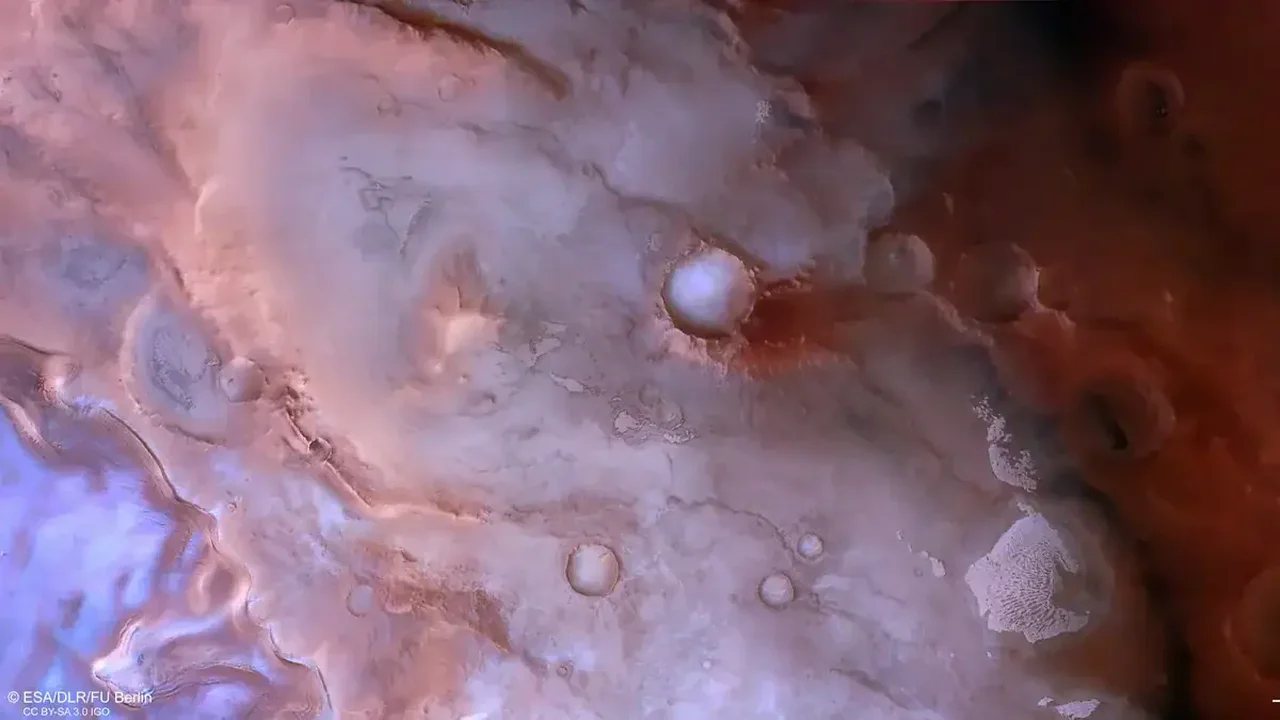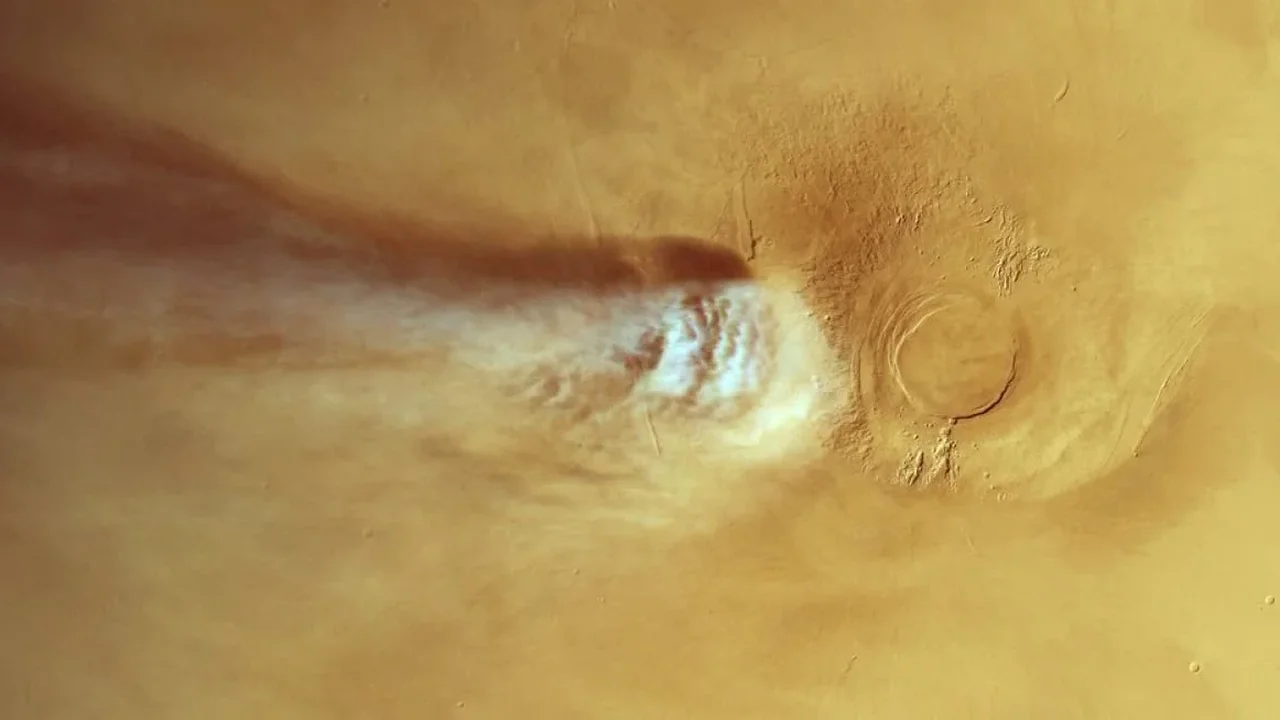
Each morning during parts of the Martian year, an immense cloud emerges near Arsia Mons, one of the Solar System's tallest volcanoes. It can extend up to 1,800 kilometres across Mars before fading within hours, creating one of the planet's most striking atmospheric events.
A volcano-driven weather system
The phenomenon, known as the Arsia Mons Elongated Cloud, develops during spring and summer in Mars' southern hemisphere. Winds meeting the volcano's vast slopes force moist air rapidly upward, where it expands and cools at exceptional speed.
Researchers calculate that temperatures can fall by around 30°C in just 10 minutes, dropping below minus 143°C. At roughly 45 kilometres above the surface, the resulting ice particles are carried westward by winds, producing the cloud's long, narrow form.
An unusual route to cloud formation
New modelling suggests that conventional dust-based cloud formation alone cannot account for the cloud's scale. Instead, the team proposes that water vapour may freeze directly into ice crystals through homogeneous nucleation.
On Earth and Mars, clouds typically begin when water condenses around tiny airborne particles such as dust or salt. Above Arsia Mons, however, rapid cooling may create extreme supersaturation, allowing water molecules to cluster and freeze without these usual microscopic starting points.
When this process was included in atmospheric simulations, researchers were able to reproduce the cloud's broad behaviour, including its narrowing structure and eventual separation from the volcano. The model did not match every detail: its version formed later, was narrower and reached a shorter maximum length than the real phenomenon.
Data collected by the European Space Agency's Mars Express mission since 2018 has been central to understanding this recurring feature. The findings, published in Nature Geoscience, could offer some of the strongest evidence yet that water-ice clouds can form directly from vapour in a planetary atmosphere.
As researchers test whether similar processes operate elsewhere on Mars, this work may refine models of atmospheric water cycles on Mars, Earth, Venus and beyond.