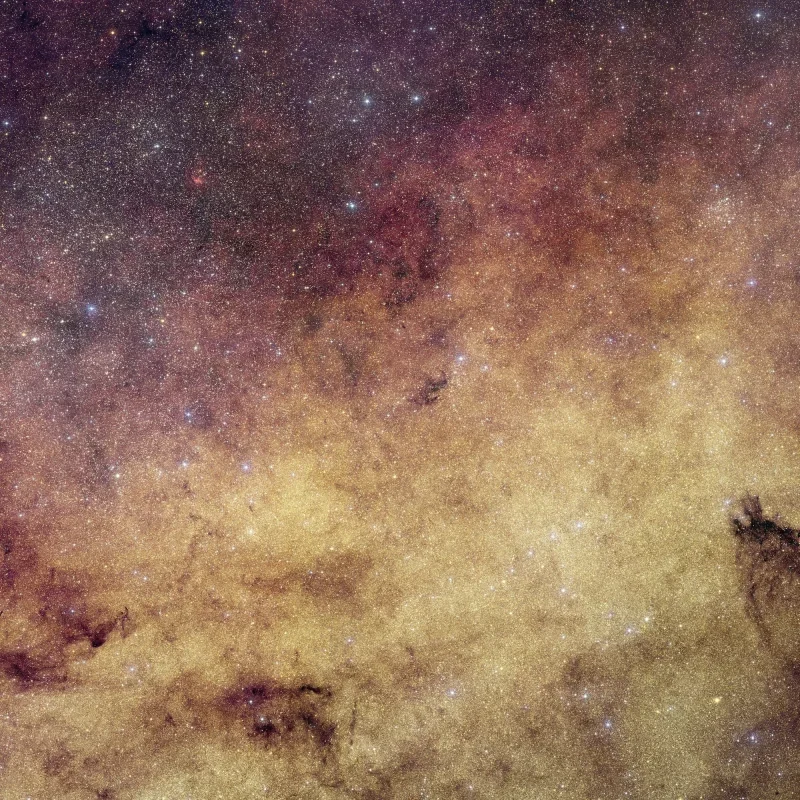
The European Space Agency's Euclid mission has delivered a striking new look at the Milky Way's crowded center, capturing the highest-resolution view yet of the galaxy's galactic bulge. The image, taken in March 2025, maps a dense region filled with ancient stars and complex cosmic structures.
More than 60 million stars appear in the frame, alongside nebulae, star clusters, and dark molecular clouds that shape the scene. Beyond its visual impact, the image is scientifically valuable: researchers can use it to study exoplanets through microlensing, a method that tracks small changes in starlight over time.
ESA notes that the bulge is a tightly packed central zone dominated by older, cooler stars, which gives it a warm yellow tone in visible light. Euclid's sharpness and sensitivity in this range are comparable to Hubble's wide-field imaging, while each observation covers a much broader area of sky in just a few hours.
This combination of depth, scale, and precision makes Euclid a powerful tool for mapping our galaxy and uncovering hidden planetary systems. As astronomy enters a new era of wide-field detail, such missions may reshape how humanity explores the structure of the Milky Way and the worlds beyond it.