Recent research conducted by the University of Colorado Boulder has unveiled a fascinating phenomenon: when tango dancers move in unison, their brains may actually synchronize, creating a deeper connection beyond mere physical coordination.
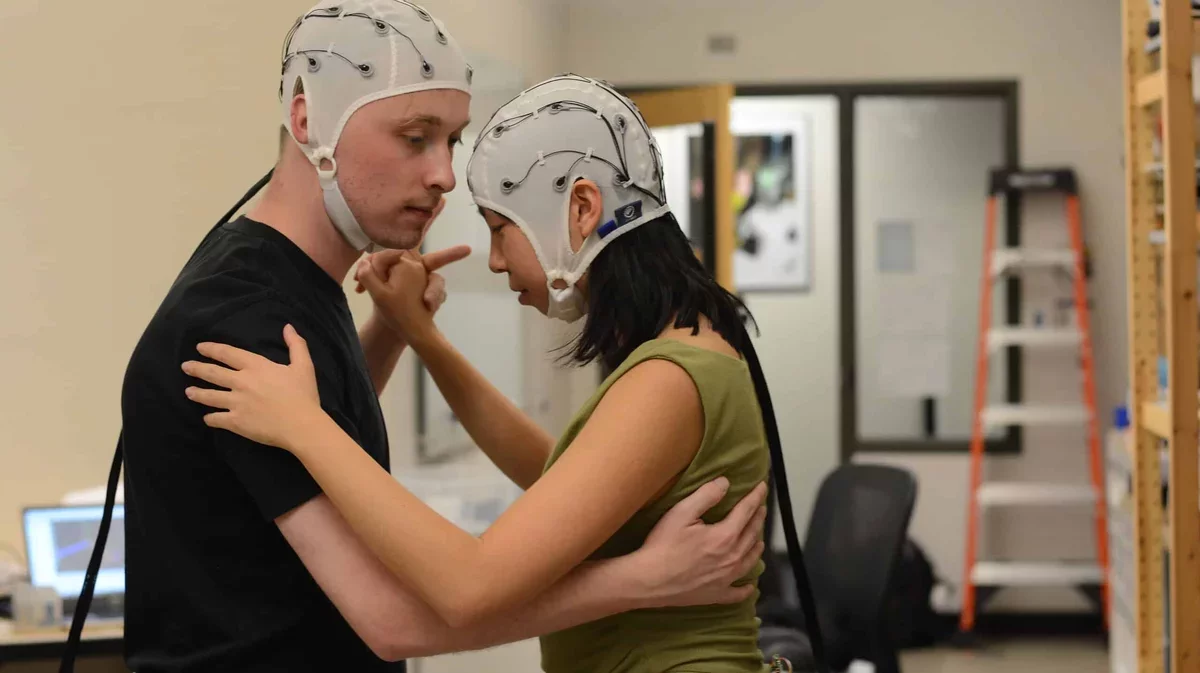
Utilizing EEG caps to monitor brain activity alongside ankle motion sensors, the study observed ten experienced Argentine tango dancers. The findings revealed that as partners executed synchronized steps, their brainwaves exhibited a remarkable degree of alignment, a phenomenon known as inter-brain coupling. This intriguing effect has been previously documented in contexts such as musical performances and cooperative tasks, but this study marks a significant exploration into its occurrence during partner dancing.
"When we dance, our brains are actually coupling," stated Thiago Roque, a graduate student at CU Boulder and the study's lead researcher. "We are synchronizing our brains through our behavior."
While the study involved a small group of five dance pairs, the results underscore how elements like touch, timing, and movement can facilitate a silent yet profound connection between individuals. The researchers also developed a prototype wrist device that vibrates to indicate when dancers' brain activity aligns, potentially paving the way for innovative training tools in various fields such as music, sports, and rehabilitation.
A Dance Built on Prediction
The Argentine tango serves as an ideal model for examining brain synchronization due to its improvisational nature. Unlike structured ballroom dances, tango requires partners to adapt their movements in real-time, often anticipating each other's actions through subtle cues. Ruojia Sun, a co-author of the study and tango enthusiast, expressed her appreciation for the unique connection fostered through this dance form.
The research team engaged ten tango dancers, each with an average of 12 years of experience, to explore the hypothesis that dance enhances synchrony in human brains. By conducting trials without music, they aimed to isolate the effects of movement on brain activity.
When Feet Align, So Do Brain Waves
In their experiments, the researchers defined synchronized steps as those occurring within 200 milliseconds of each other. Notably, the EEG data revealed significant inter-brain coupling during these synchronized movements, particularly across various brain-wave frequencies associated with attention and coordination.
"The coupling was even better than I expected," Roque remarked, highlighting the study's promising implications for understanding human connection through movement.
While the study's small sample size presents limitations, its broader implications are significant. Many human activities, from team sports to collaborative performances, rely on silent coordination. Roque emphasized the potential of such research to enhance training methods, allowing individuals to better anticipate and respond to their partners' actions.
The innovative feedback system, named HyperDance, transforms brain synchronization data into tactile sensations, creating a new layer of interaction for dancers. This device could revolutionize how performers train, fostering deeper connections through enhanced awareness of mutual coordination.
Published in the proceedings of the 20th International Conference on Tangible, Embedded, and Embodied Interaction, this study opens new avenues for exploring the intersection of neuroscience and the arts, potentially reshaping our understanding of human connection and collaboration in the future.