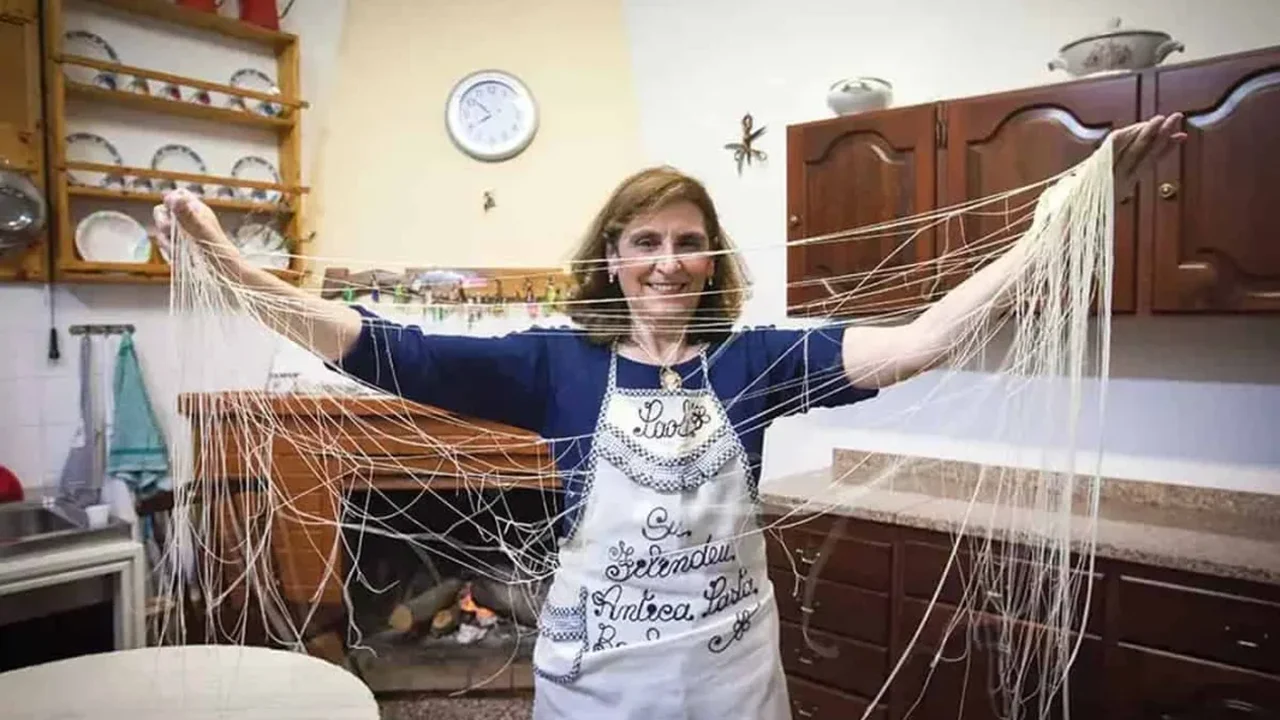
Sardinia is home to one of the world's most remarkable culinary traditions: su filindeu, a pasta so delicate and rare that only a handful of people are believed to know how to make it. Built from just semolina, water, and salt, it becomes a lattice of 256 ultra-thin strands through a fully manual process guided by touch rather than measurements.
A craft shaped by precision and memory
The technique has been passed through generations of the Abraini family, with Paola Abraini learning it nearly 50 years ago from her mother-in-law. She kneads the dough until it reaches the right elasticity, then stretches and folds it repeatedly until the strands become almost threadlike. The finished layers are arranged on a round wooden tray and dried under the Sardinian sun.
Once hardened, the fragile sheets are broken into pieces and served in a traditional broth of sheep or mutton, often finished with pecorino cheese during the Feast of San Francesco. The dish is closely tied to pilgrimage culture in the Nuoro-to-Lula route, where the pasta has long been part of the celebration.
A living heritage under pressure
Despite interest from chefs and food companies, the recipe remains extremely difficult to reproduce at scale. That rarity has also made it a symbol of cultural preservation. The dish is listed in Slow Food's Ark of Taste, which highlights foods and traditions at risk of disappearing.
Abraini has begun teaching people outside her family, a notable shift that could help keep the craft alive. If more makers learn the technique, su filindeu may continue to connect heritage, skill, and identity for future generations.