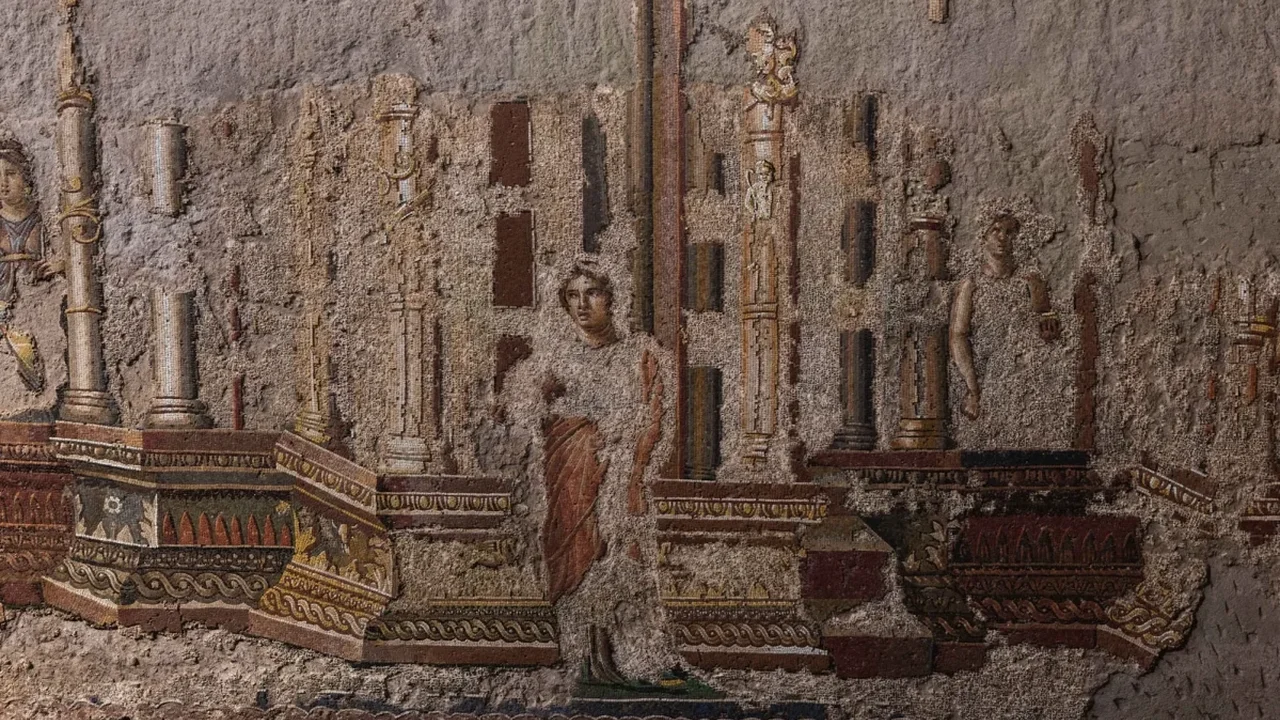
Rome has opened a remarkable new chapter in its cultural heritage with the public unveiling of the Great Mosaic, an ancient work believed to be among the largest ever excavated from the Roman world.
Measuring approximately 33 feet wide and 52.5 feet high, the mosaic is now preserved within the newly opened Museum of the Baths of Trajan on the Oppian Hill. The monumental bath complex was commissioned by Emperor Trajan in the early second century and once extended across nearly 15 acres in central Rome.
A layered story beneath the city
Archaeologists discovered the Great Mosaic in 2011 and have since carried out a detailed conservation process while gradually revealing more of its composition. The work remains in its original archaeological setting, allowing visitors to experience it within the architectural context where it was found.
Its surviving tesserae form elaborate architectural scenes, statues associated with the Muses, decorative motifs, and marble-like patterns. Researchers suggest that part of the composition may depict a two-level theatrical backdrop known as a scaenae frons, reflecting the visual sophistication of Roman public spaces.
The origins of the mosaic are still being explored. The Baths of Trajan incorporated parts of Nero's earlier Domus Aurea, though specialists have not yet confirmed whether the artwork belonged to that imperial residence or to another luxurious structure later absorbed into the complex.
The museum also presents the "Painted City," an architectural fresco uncovered during earlier excavations. Its detailed urban setting, featuring plazas and towers, may represent either an imagined cityscape or a stylized interpretation of a port settlement.
Excavation continues in sections of the Great Mosaic, including areas with imagery linked to grapes and winemaking. This new public display demonstrates how long-term conservation can transform archaeological discoveries into living cultural experiences. It may also encourage future museum projects that connect historic sites with more immersive, accessible ways of understanding the past.