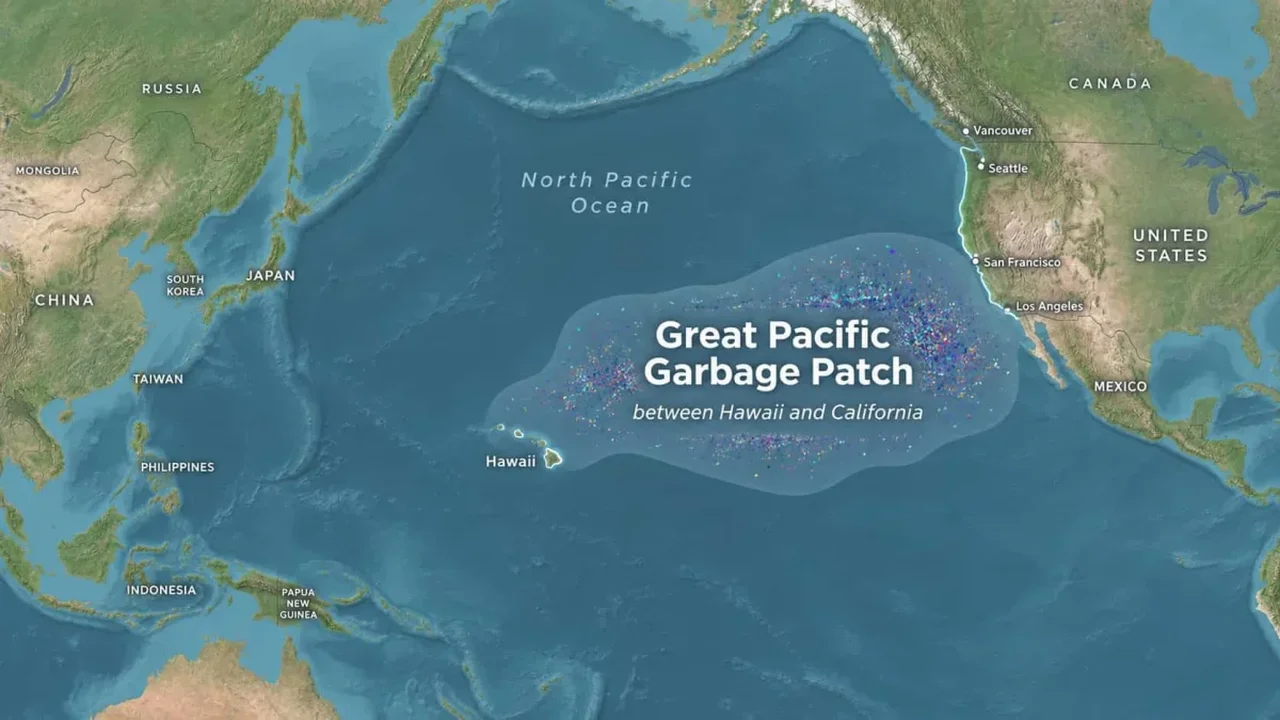
Parts of the Pacific near the Great Pacific Garbage Patch have reflected more blue and green light over the past two decades. Researchers from the University of Bergen say microscopic plastic particles may be contributing to the shift, though the explanation is not yet confirmed.
The team analyzed ocean-color data spanning August 2002 to September 2022, including observations from NASA's Aqua satellite and ocean-color datasets developed by ESA and the Copernicus programme. The records showed a shared cyan-like signal in waters around the accumulation zone.
A possible optical clue
Microplastics can scatter visible light, and laboratory work suggests the effect may be particularly noticeable near the boundary between blue and green wavelengths. The researchers tested whether this could help explain the satellite observations.
In more than 50,000 computer simulations, around 3% of scenarios involving natural changes alone produced a similar signal. When microplastic changes were included, the figure rose to about 13%. This makes the plastic explanation more consistent with the observed pattern, but does not prove that microplastics caused it.
The approach could eventually help scientists monitor vast ocean areas where tiny particles are difficult to sample directly. The study, published in Communications Earth & Environment, identifies field measurements as a necessary next step to determine whether the satellite signal can reliably distinguish plastics from natural changes in the water.
If validated, satellite monitoring could give researchers a broader, more frequent view of microscopic ocean pollutants and support more informed environmental research.