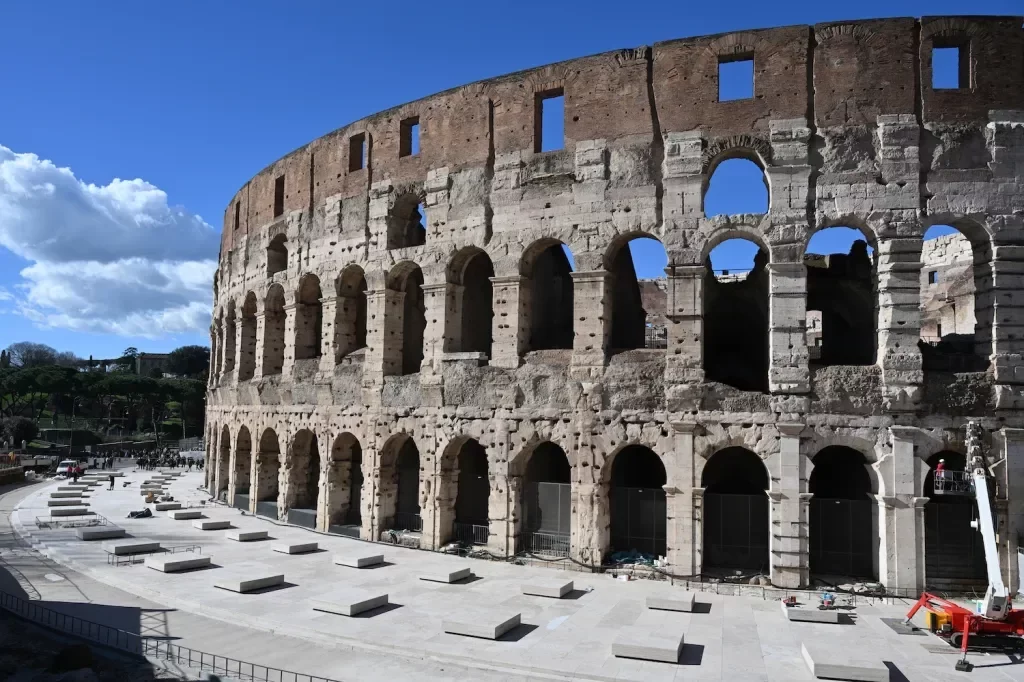
The restoration of the southern piazza of the iconic Roman Colosseum has reached its conclusion after four years of dedicated work. Spearheaded by Stefano Boeri Interiors, this project has successfully recreated the travertine-paved pedestrian plaza that once served as the main entrance for spectators eager to witness the grandeur of the arena.
Constructed between 70 and 80 CE, the Colosseum stands as a testament to ancient engineering prowess. With its impressive four-story height and 80 arched entrances, it could accommodate over 50,000 spectators, rivaling modern stadiums in capacity. Its freestanding structure, supported by an intricate vault system, remains a marvel of architectural innovation.
The amphitheater was designed with a retractable awning system to shield attendees from the sun, and it included facilities such as latrines and water fountains. Historically, it hosted a variety of events, including gladiatorial contests where enslaved individuals and prisoners fought for survival, along with public executions and even mock naval battles that filled the arena with water.
Following the decline of the Roman Empire, the Colosseum transitioned into a Christian sanctuary and later transformed into a fortress. After sustaining damage from an earthquake in 1349, it was abandoned and repurposed as a quarry for construction projects, such as St. Peter's Basilica. Efforts in the 1800s, led by Pope Pius VIII, aimed to preserve this monumental structure, resulting in the restoration visitors admire today.
The southern facade of the Colosseum originally featured a two-story arcade with towering columns exceeding 160 feet. Rather than reconstruct the facade, the architects chose to mark the original column placements with plinths made from the same stone used in the newly restored piazza.
Stefano Boeri expressed his enthusiasm about the project, stating, "This restoration has revived the perception of the monument's original size and floor level. It allows the public to approach its walls and envision the rhythm and sequence of the ambulatories and arches, which have been lost over time."
This revitalization not only enhances the visitor experience but also reinforces the cultural significance of the Colosseum as a historical landmark. As urban spaces evolve, such projects highlight the importance of preserving our heritage while making it accessible for future generations.