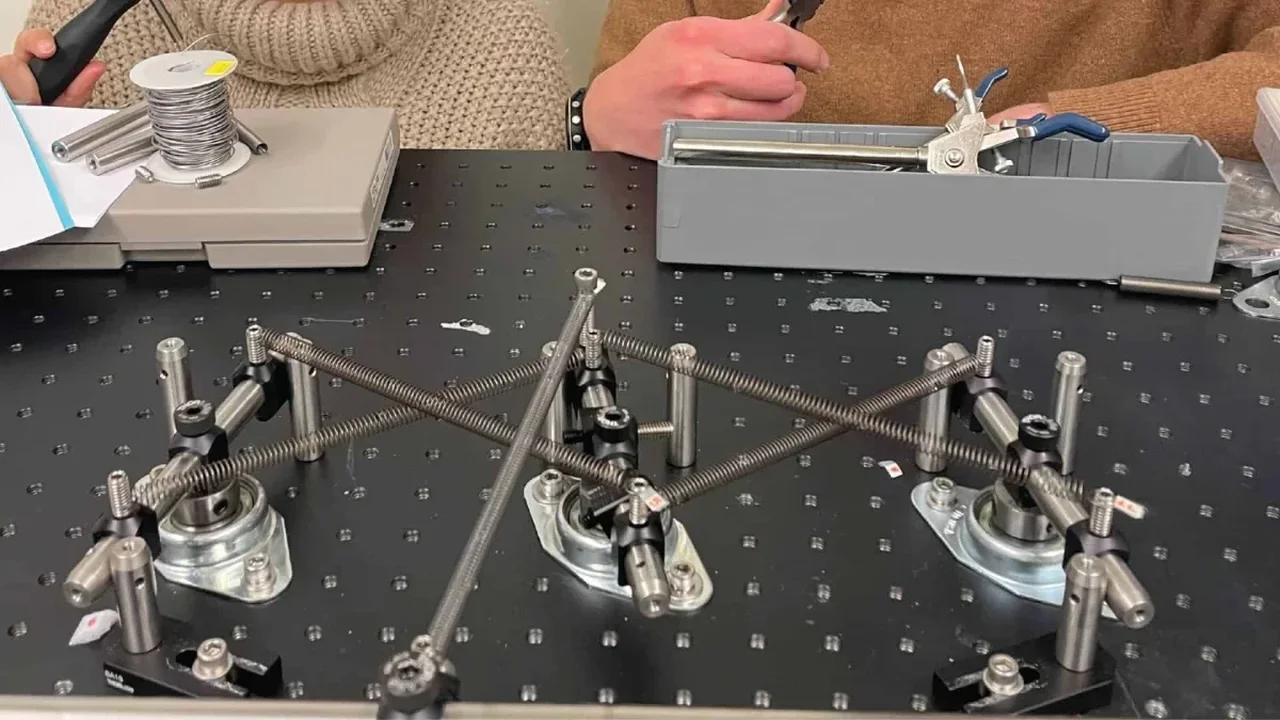
Researchers at St. Olaf College and Syracuse University have developed a working computer built entirely from rigid steel bars and springs -- and it operates without a single watt of electricity. Instead of silicon chips or wires, the system uses physical motion, tension, and carefully designed mechanical thresholds to process information.
The project is less about replacing modern computers and more about reimagining how materials themselves can compute. The team designed bistable units known as hysterons, each of which switches state only after force crosses a precise point. That behavior creates a form of mechanical memory, where the system responds not just to the present push, but also to what happened before.
How the Mechanical Logic Works
By linking multiple hysterons with springs, the researchers built interactions that can cooperate, oppose one another, or even behave in a non-reciprocal way. This gave the platform enough flexibility to perform simple computing tasks such as counting, distinguishing odd and even inputs, and storing information about the strength of a push.
The team demonstrated three separate devices: a physical counter, a modulo-2 logic system, and a latching mechanism that holds a state until a stronger force resets it. Together, they show that computation can emerge from structure and motion alone.
According to the researchers, the broader goal is to inspire smart materials that can sense their environment, make decisions, and respond without conventional electronics. Such systems could one day support responsive prosthetics, adaptive surfaces, or machines designed for extreme environments.
While the current prototype is still an academic demonstration, it points to a new design philosophy: intelligence embedded directly into matter. If that idea continues to grow, future materials may not just support technology -- they may actively participate in it.