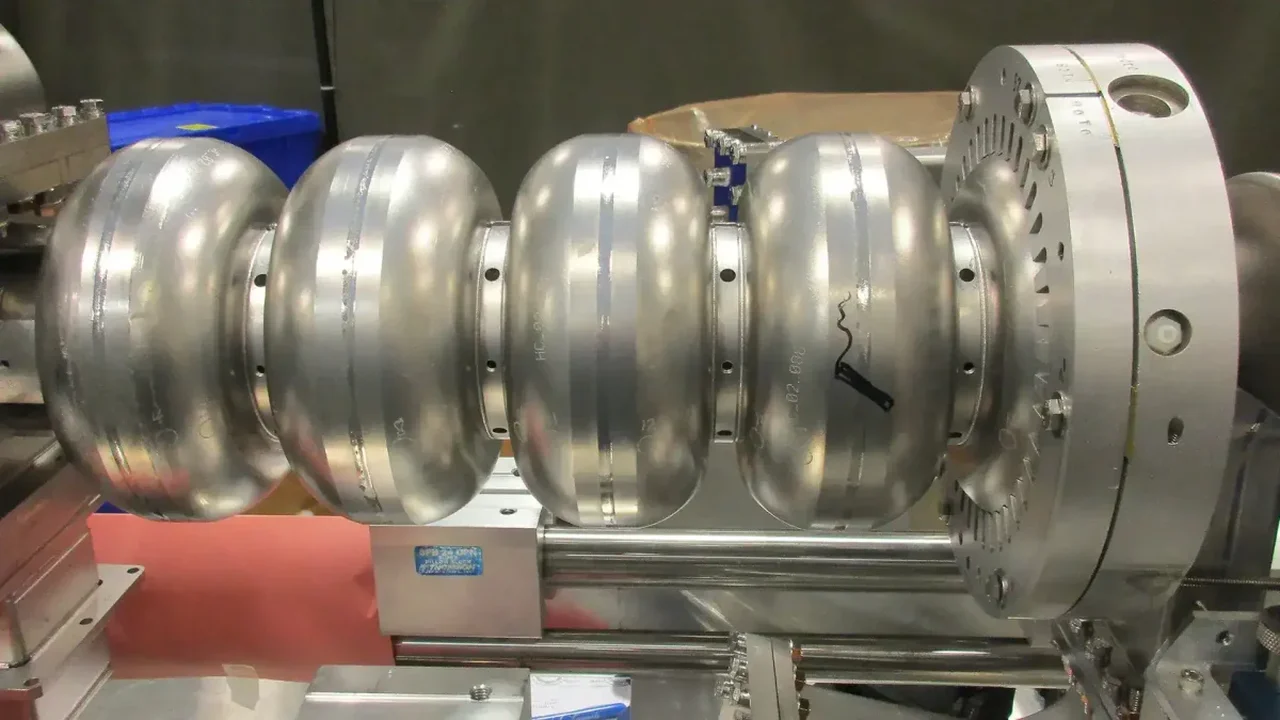
Advanced particle accelerator technology may offer a new path for managing used nuclear fuel, turning some of its longest-lasting radioactive elements into materials that decay far more quickly.
A New Role for Accelerator Science
Conventional nuclear reactors leave behind transuranic isotopes such as plutonium-239 and americium-241. While much of the radioactivity from used fuel declines over several centuries, these elements can remain active for tens of thousands of years.
A proposed solution combines a powerful particle accelerator with a subcritical reactor. Unlike conventional reactors, a subcritical system cannot sustain a chain reaction independently. It requires a controlled external neutron source, allowing researchers to target long-lived isotopes more precisely.
In this approach, high-energy protons strike a heavy material, producing neutrons through spallation. These neutrons can then convert persistent radioactive isotopes into shorter-lived forms. According to the U.S. Department of Energy's ARPA-E program, the process could potentially reduce the required management timeline for selected waste components from around 100,000 years to roughly 300 years.
From Long-Term Storage to Energy Potential
The transmutation process also generates heat, creating an opportunity to produce additional electricity while processing nuclear materials. This dual-purpose model could position used fuel not only as a storage challenge, but also as a future energy resource.
Thomas Jefferson National Accelerator Facility is leading two research projects under ARPA-E's Nuclear Energy Waste Transmutation Optimized Now program. The work focuses on improving accelerator efficiency, reliability and operating costs.
One area of development involves coating niobium accelerator cavities with tin. These superconducting surfaces could operate at higher temperatures than traditional designs, reducing dependence on complex cryogenic infrastructure. Researchers are also examining new cavity geometries and advanced magnetron systems to supply accelerator power more efficiently.
With industrial and laboratory partners supporting the program, accelerator-driven transmutation is moving closer to practical evaluation. If scaled successfully, the technology could reshape how future energy systems view long-lived nuclear materials: not simply as waste, but as a manageable resource for cleaner, more circular energy infrastructure.