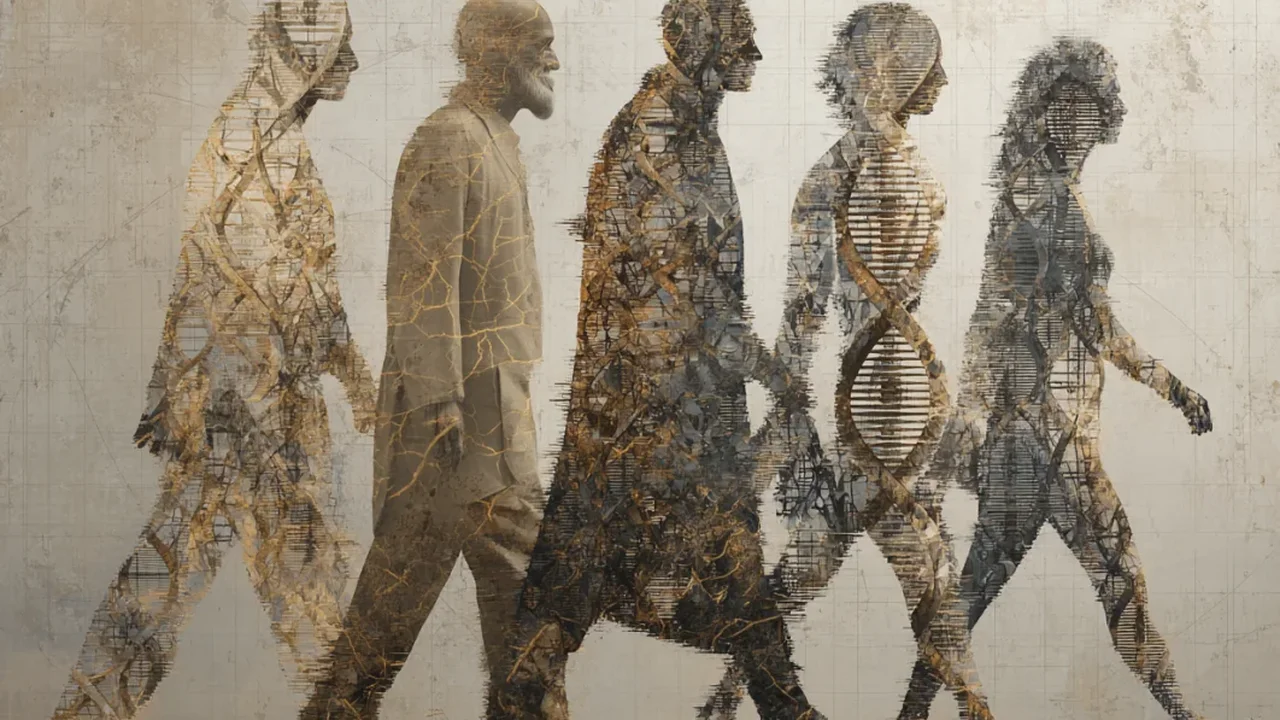
Human evolution may be entering a new chapter in which culture increasingly shapes adaptation faster than genetic change, according to a hypothesis proposed by University of Maine researchers Timothy Waring and Zachary Wood.
In a 2025 paper published in BioScience, the researchers argue that medicine, education, technology, agriculture and social institutions can help people respond to challenges within generations. Genetic evolution, by contrast, typically unfolds over much longer timescales.
Culture as an Adaptive System
Tools such as eyeglasses, assisted reproduction and surgical care can alter how biological differences affect everyday life without waiting for genetic traits to spread through populations. Waring and Wood suggest these cultural solutions may sometimes reduce or redirect the influence of natural selection.
The idea is not that genes have stopped mattering. Instead, the researchers propose that inherited knowledge, shared practices and technological systems are becoming more central to human survival and development. This process has roots in early agriculture and urban societies, but may now be accelerating through globally connected institutions and scientific innovation.
A Debate About Human Collectives
Waring and Wood also explore whether deeply interconnected societies could eventually take on features resembling a cultural superorganism. Modern communities depend on extensive cooperation, specialised work, public systems and accumulated knowledge created across generations.
However, the proposal remains actively debated. Researcher Arsham Nejad Kourki argues that cooperation alone does not make a society an evolutionary individual. In biological transitions, a collective must reproduce and undergo selection as a unified entity--criteria that human societies do not clearly meet.
The University of Maine team acknowledges that its long-term scenario is speculative. Their next step is to develop measurable tests that compare the influence of cultural inheritance with genetic inheritance across historical and contemporary populations.
What is already clear is that humans increasingly rely on knowledge built by others. As science, technology and institutions evolve, understanding the relationship between culture and biology could offer a powerful framework for exploring humanity's future adaptability.