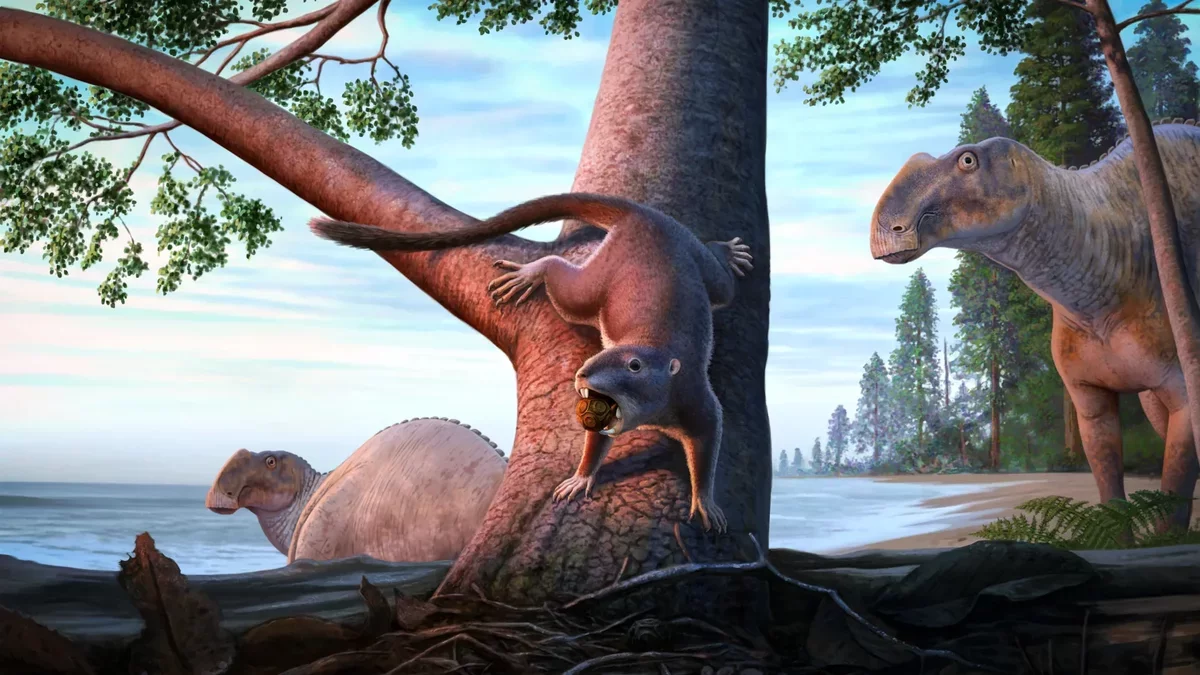
A groundbreaking discovery has emerged from the University of Washington, where a team of researchers has identified a new species based on a fossil found in Baja California, dating back approximately 75 million years. This newly designated species, Cimolodon desosai, is comparable in size to a golden hamster and is believed to have navigated both terrestrial and arboreal environments, feeding on fruits and insects.
The research findings were published on April 22 in the Journal of Vertebrate Paleontology. Senior author Gregory Wilson Mantilla, a biology professor and curator of vertebrate paleontology at the Burke Museum, noted, "The genus Cimolodon was quite prevalent during the Late Cretaceous, the final period of the Age of Dinosaurs. Fossils of this genus have been discovered throughout western North America, from Canada to Mexico." He added that C. desosai is ancestral to species that survived the mass extinction event, possessing traits such as small size and omnivorous diet that were advantageous for survival.
Significant Fossil Discovery
The fossil was initially discovered in 2009 by Mantilla and his team. Unlike many fossil finds that consist solely of teeth, this specimen provided a comprehensive array of remains, including teeth, a skull, jaws, and parts of the skeleton like a femur and ulna.
"Fossil finds at this site are rare compared to other locations," Mantilla remarked. "Initially, my field assistant uncovered a small tooth. Had that been all we found, I would have been thrilled. However, upon examining the rock further, we discovered more bones." This extensive collection of remains allowed researchers to infer the animal's size, structure, and movement patterns, enriching the understanding of the multituberculates' ecological context.
Innovative Imaging Techniques
To analyze the fossil, the team employed advanced digital imaging and micro-computed tomography (micro-CT), which yields highly detailed visuals. They compared the teeth of C. desosai with those of other species within the Cimolodon genus to confirm its uniqueness.
"In paleontology, species are often classified based on tooth characteristics," Mantilla explained. "Finding a skeleton without teeth complicates the identification process."
A Tribute to the Discoverer
The species name honors Michael de Sosa VI, the field assistant who first spotted the fossil but sadly passed away during the research process. "He was an exceptional field assistant and felt like a younger brother to me," Mantilla expressed. "It's a fitting tribute to associate him with such a remarkable specimen."
Co-authors of this research include Isiah Newbins, David Fastovsky from the University of Rhode Island, and others from the Universidad Nacional Autónoma de México.
This research was supported by various institutions, including UC MEXUS-CONACYT and the UW College of Arts and Sciences.