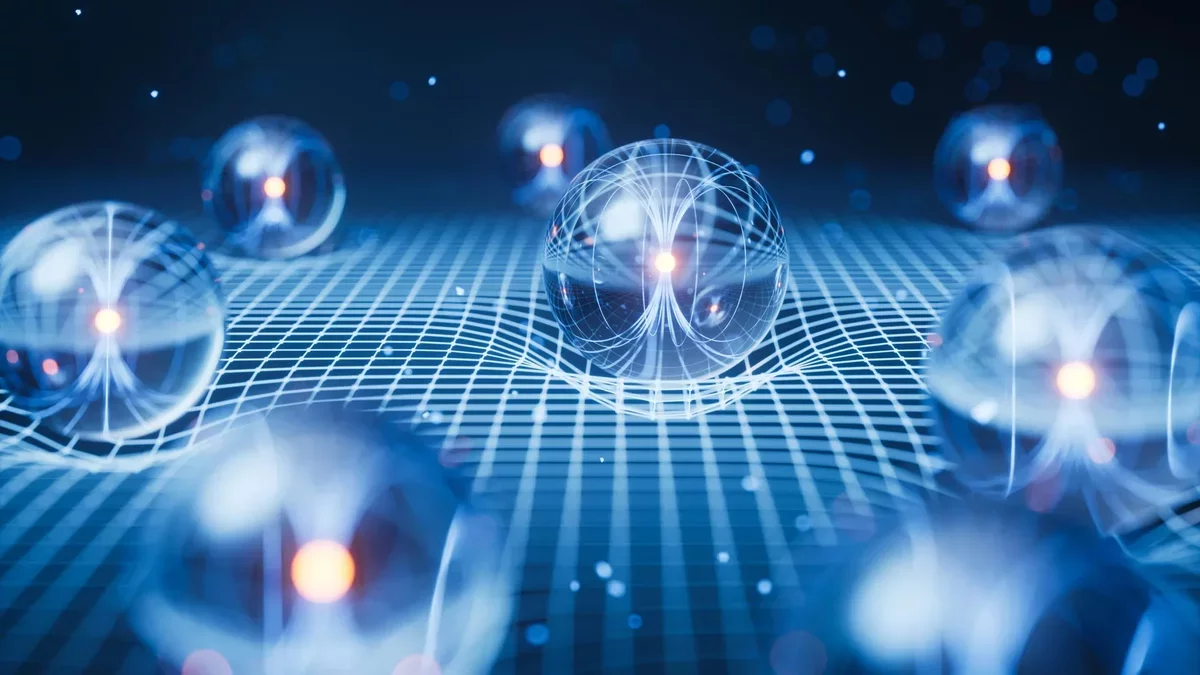
Quantum circuits function similarly to a series of interconnected operations, processing information in a highly coordinated manner. However, these circuits can be influenced by instability, referred to as "noise." This seemingly minor disturbance can accumulate over time, potentially disrupting the entire operation.
Exploring the Impact of Noise on Quantum Computing
This raises a pivotal question: does increasing the complexity of quantum circuits still yield advantages in the presence of noise? Quantum circuits are fundamental to the advancement of quantum computers, which aspire to tackle problems beyond the capabilities of classical systems.
A recent theoretical study conducted by researchers Armando Angrisani and Yihui Quek from EPFL, Antonio Anna Mele from the Free University of Berlin, and Daniel Stilck França from the University of Copenhagen delves into this issue. Their findings, published in Nature Physics, indicate that noise imposes a significant limit on the depth of quantum circuits, affecting the number of sequential operations that can be effectively executed. Moreover, they discovered that noise might simplify parts of these circuits, making them easier to simulate on classical computers.
Significance of the Final Steps
The research team analyzed large sets of quantum circuits constructed from basic two-qubit operations under realistic conditions, where each qubit encounters noise after every operation. Their mathematical analysis tracked how the influence of each layer propagates through the circuit. The results revealed that in most noisy quantum circuits, the outcome is predominantly determined by the final few operations.
Even in circuits designed with considerable depth, the impact of earlier operations diminishes over time. This scenario can be likened to a series of dominoes, where only the last few pieces dictate the final outcome.
This finding holds significant implications for quantum computing. When utilizing a quantum computer to determine properties like energy or the state of a qubit, the results are largely influenced by the concluding layers, as earlier operations lose relevance due to noise accumulation.
Training Noisy Quantum Circuits
The study also sheds light on why noisy quantum circuits can still be adjusted or "trained" for specific tasks. Modifying the settings of a circuit can impact the results, primarily because the final layers remain influential.
Consequently, a noise-affected deep circuit can behave similarly to a shallower one, as additional steps do not necessarily enhance performance due to the diminishing contribution of earlier operations.
Implications for the Future of Quantum Technology
This research offers a clearer understanding of the realistic capabilities of current quantum machines. Simply increasing circuit depth may not yield better outcomes for many tasks, particularly those reliant on local measurements. Future advancements are likely to hinge on minimizing noise or devising circuits that can operate effectively despite it. This study also challenges a common misconception: while noisy circuits may seem trainable, this perception arises from the noise's reduction of their effective complexity, cautioning against unrealistic expectations regarding the true potential of quantum computing.