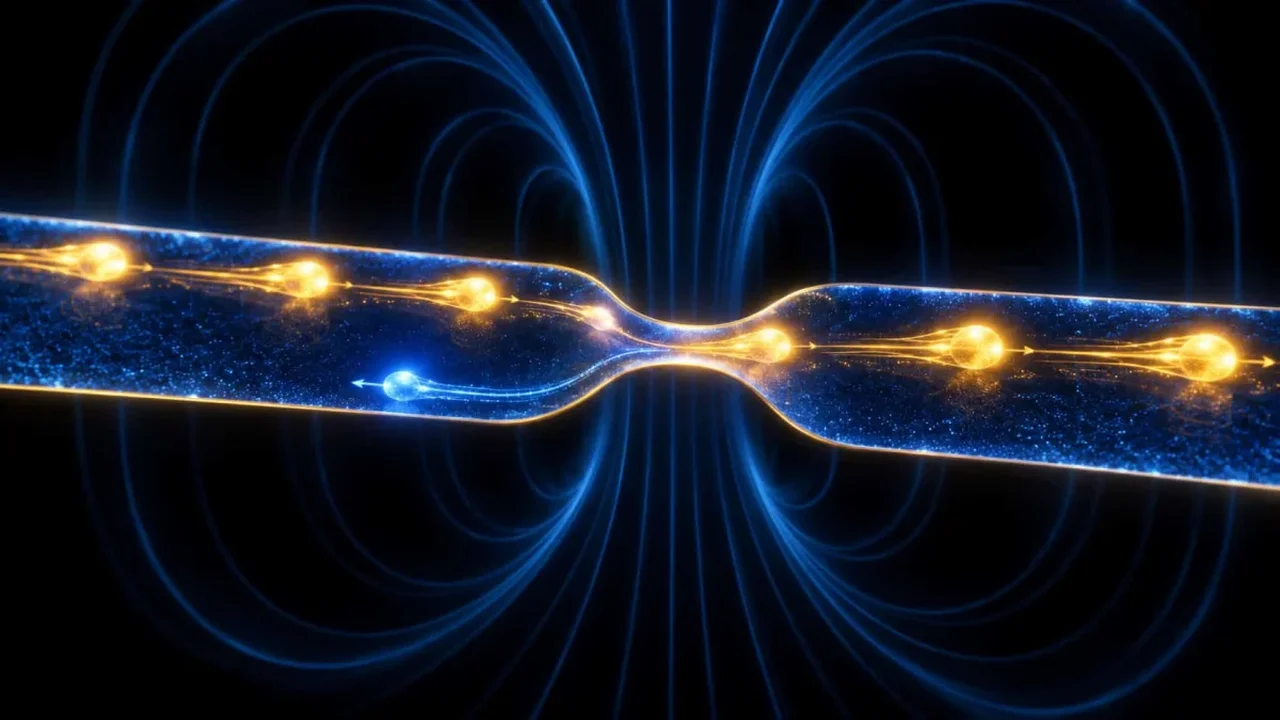
While the potential of osmotic energy remains vast, significant challenges have hindered its practical application. Membranes designed for rapid ion passage often struggle with charge separation and structural integrity, limiting most osmotic energy systems to laboratory environments.
Breakthrough with Lipid-Coated Nanopores
Researchers from the Laboratory for Nanoscale Biology (LBEN), led by Aleksandra Radenovic at EPFL's School of Engineering, in collaboration with the Interdisciplinary Centre for Electron Microscopy (CIME), have made strides in overcoming these obstacles. Their findings, published in Nature Energy, reveal a novel approach to enhance ion mobility.
The team utilized lipid bubbles, known as liposomes, to coat nanopores. Typically, these nanopores allow ions to flow with precision but at a sluggish pace. However, with the lipid layer, the movement of selected ions becomes significantly easier, as the reduced friction dramatically boosts ion transport and overall system performance.
"Our research merges two primary strategies in osmotic energy harvesting: the high-porosity architecture inspired by polymer membranes and the precise engineering of nanofluidic devices," states Radenovic. "This combination facilitates efficient osmotic energy conversion, paving the way for advanced nanofluidic blue-energy systems."
Hydration Lubrication Mechanism
The lubrication technique employed involves lipid bilayers, which are similar to those found in living cell membranes. These bilayers form naturally when two layers of fat molecules align with their hydrophobic tails inward and hydrophilic heads outward.
When applied to stalactite-shaped nanopores within a silicon-nitride membrane, the hydrophilic heads attract a minuscule layer of water. This thin water layer, merely a few molecules thick, adheres to the nanopore surface, minimizing direct ion interaction and thereby reducing friction. Consequently, ions can traverse the pores more efficiently.
Enhanced Power Output for Blue Energy
The researchers constructed a membrane featuring 1,000 lipid-coated nanopores arranged in a hexagonal design and evaluated its performance under conditions simulating the natural salinity where seawater and river water converge. The device achieved a power density of approximately 15 watts per square meter, which is 2-3 times greater than existing polymer membrane technologies.
Progress Towards Practical Blue Energy Solutions
Prior simulations indicated that enhancing ion flow and selectivity in nanofluidic channels could significantly improve osmotic energy generation. However, empirical demonstrations of simultaneous improvements have been scarce.
"Our study illustrates how meticulous control over nanopore geometry and surface characteristics can revolutionize ion transport, advancing blue-energy research into a design-centric phase," remarks LBEN researcher Tzu-Heng Chen.
First author Yunfei Teng highlights the broader implications of their "hydration lubrication" approach. "The enhanced transport behavior we observe, driven by hydration lubrication, is universal and can extend beyond blue-energy applications," he notes.
Collaboration and Advanced Research Facilities
This project benefited from extensive analysis of nanopore structure and chemical properties, conducted by Dr. Victor Boureau at CIME, along with support from EPFL's advanced research facilities for nanofabrication, materials characterization, and high-performance computing.